Former Projects in the DeepDive Master
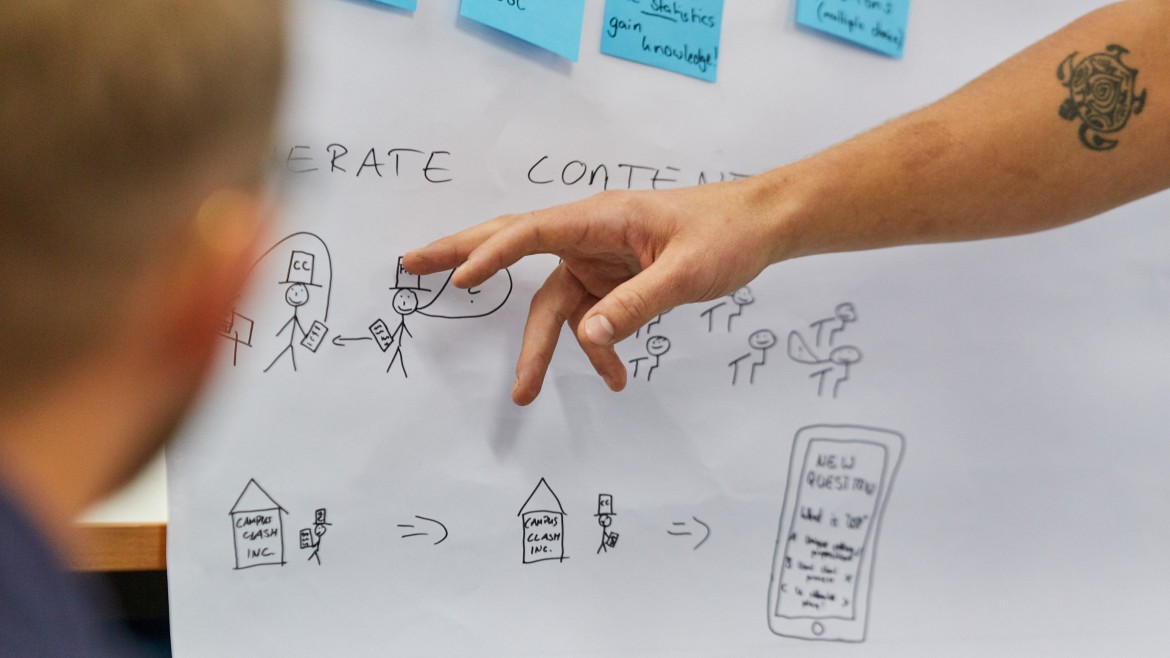
Depending on your background and goals, you will join either an entrepreneurship project or a co-creation project.
In the entrepreneurship track, you develop and validate your own digitally enhanced business idea. Projects may focus on areas such as mobility, health, food, or manufacturing, or on a topic you bring to the program. You present your idea to your peers and need to convince other students to join your project so that a team is formed and the idea can be pursued.
In the co-creation track, you collaborate with corporate partners to develop innovative solutions to real-world digital challenges. Each project team is supported by both a professor and a startup coach.
Want to see what previous cohorts worked on? Explore our project descriptions below from past batches.
Entrepreneurship projects in the field of mobility are accelerated by our close partnership with EIT Urban Mobility:

Our Entrepreneurship-Projects
About-Watt (supported by EIT Urban Mobility)
Six students from Germany, India, Pakistan, and Bosnia and Herzegovina developed About-Watt, a circular energy concept that envisions turning used EV batteries into certified home storage systems. With more than one million EV batteries expected to retire in Germany by 2030, the team proposes a plug-and-play solution that could extend battery life by up to ten years, reduce CO₂ emissions, and offer affordable access to clean energy. Backed by early customer interest and a confirmed pilot engagement, and with ongoing discussions with European OEMs, About-Watt positions itself at the forefront of sustainable energy innovation.
Nimo (supported by EIT Urban Mobility)
Nimo (Nomads in Motion) is a subscription-based mobility platform for people living in a city temporarily - such as exchange students, digital nomads, and short-term professionals. Built by a seven-student team from Germany, Iran, Peru, Egypt, India, and Pakistan, Nimo partners with local bike shops to offer professionally refurbished used bikes on flexible, stay-length subscriptions. The result: hassle-free, affordable mobility for users - and recurring revenue for bike shops through better use of existing inventory.
Unbooked
Unbooked is a workflow-focused software concept for small and mid-sized catering businesses that are still juggling inquiries, offers, planning, and internal coordination across emails, spreadsheets, and messaging apps. Created by a seven-student team from Germany and Turkey, the solution streamlines the process from first client request to event execution: a smart inquiry form captures the right information upfront, turns it into structured tasks, supports faster quote creation with templates, and connects everything in one place. The goal is simple: less back-and-forth, fewer errors, faster response times, and a clear operational overview - without forcing caterers into complex “enterprise” tools.
ODA
ODA is a digital platform that connects young professionals and graduates who feel uncertain about their career direction with experienced industry insiders. Developed by a team of four students from Russia, Germany, Iran and Greek, ODA helps to reduce career disorientation through personalized 1:1 consultations made via smart matching. ODA’s long-term vision is to build a comprehensive career hub - guiding users from self-exploration to real job outcomes. They are also part of the SCE incubation program.
BrandBrain
Brand Brain is an AI-powered knowledge platform built by a multicultural team from Germany, Iran, Azerbaijan, and Taiwan that solves a key problem for guilds and associations: law-heavy institutional knowledge scattered across too many places, making reliable answers slow and inconsistent. Instead of forcing staff and members to search through newsletters, regulations, agreements, and meeting notes, it supports guided knowledge structuring and an AI co-pilot that turns these documents into clear, source-linked responses. The result is fast, reliable access to guild know-how, piloted with bakery guilds, improving everyday member support, enabling continuous process improvements, and reinforcing compliance.
Our Co-Creation Projects
Cherry (in cooperation with Airbus Helicopters)
Cherry is a co-creation project developed with Airbus Helicopters that tackles a costly bottleneck in B2B sales: creating and customizing high-quality marketing visuals for complex aerospace products. Developed by a six-person team from students from Ghana, Germany, South Korea, Spain, and Croatia, Cherry proposes an AI-based image generation solution that streamlines workflows, speeds up personalization (e.g., variants, configurations, contexts), and helps sales teams respond faster to customer needs - while meeting enterprise requirements around quality, security, and data control. The team has demonstrated that Open Source Generative AI Models can be used to create videos and pictures of complex products variations in application scenarios.
Life Cycle Assessment Index (in cooperation with TÜV SÜD)
A five-person team of students from the UK, Germany, Belarus, and Ghana developed LCA-I (Life Cycle Assessment Index) with TÜV SÜD—a sustainability rating concept that helps compare the lifecycle impact of new and used vehicles. LCA-I combines a standardized assessment with a dynamic model that accounts for a vehicle’s condition and history, creating a more realistic view across environmental, social, and economic dimensions. Designed with a strong user focus, it translates complex lifecycle data into clear, decision-ready insights for consumers, fleet managers, OEMs, and regulators.
Our Entrepreneurship-Projects
BeyondBarriers (supported by EIT Urban Mobility)
Beyond Barriers tackles one of the biggest blockers to independent urban mobility for wheelchair users: outdated and fragmented accessibility information. Based on desk research and interviews, the team found that everyday trips often require extensive planning, detours, and uncertainty - especially when elevators are out of service or accessibility details are missing. Their solution is a wheelchair-first route planning app that consolidates accessibility data in one place. Beyond Barriers aims to reduce barriers, save time, and most importantly increase autonomy and social participation for people with mobility impairments in the city.
RIVE (supported by EIT Urban Mobility)
RIVE was a mobility project developed by a six-person team that explored how everyday commuting can become more efficient through autonomy and real choice. The team designed a fully electric two-wheeled vehicle concept that could switch between road and bike-lane operation, giving commuters more flexible routing options and helping them avoid congestion without relying on public transport schedules. Complemented by a digital layer (including multi-modal navigation), RIVE aimed to make commuting across urban and suburban areas faster, smoother, and more practical.
Suitable
A team of four students set out to make job searching less overwhelming for career starters and more accurate for companies. Their project “Suitable” bridges the gap between what graduates can do and what job ads ask for: instead of browsing endless (often confusing) job titles, users start with scientifically grounded personality insights and then explore roles through task-based swiping. On top, Suitable uses AI-supported matching to connect strengths, interests, values, and soft skills with roles and company culture, helping job seekers gain clarity and confidence, while enabling employers to identify better-fit candidates earlier in the process. The goal: fewer mismatches, faster hiring, and a job search experience that feels personal, engaging, and future-ready.
Investment Co-Pilot
Investment Co-Pilot is a DeepDive project by a multicultural team from Germany, Colombia, and Azerbaijan that tackles a common barrier to investing: information overload and the time-consuming nature of thorough stock research. Instead of leaving beginners alone with earnings reports, transcripts, and endless news, the platform combines step-by-step learning resources with an AI-powered “co-pilot” that turns complex qualitative information into clear, structured, decision-ready insights. The goal is to make high-quality investment research faster, more understandable, and more confidence-building - helping users learn while they invest, and supporting smarter, more responsible financial decisions.
Our Co-Creation Projects
Bioneers (in cooperation with Zeiss)
In cooperation with ZEISS, the DeepDive team behind Bioneers explored how companies can turn biodiversity from a “nice-to-have” into a measurable, actionable part of corporate sustainability. Their project focuses on helping organizations understand where they impact nature, translate this into clear initiatives and KPIs, and build engagement across stakeholders - aligning environmental stewardship with long-term business resilience. With a strong emphasis on data, transparency, and emerging frameworks for nature-related accountability, Bioneers aims to make it easier for companies to move from commitments to credible action that protects biodiversity while supporting sustainable value creation.
HexaMinds (in cooperation with metafinanz)
HexaMinds is a DeepDive co-creation project together with Metafinanz that helps small and medium-sized enterprises make AI usable without needing an in-house data science team. The team identified a clear barrier: many SMEs see the potential of AI, but struggle with skills gaps, integration complexity, cost concerns, and trust/privacy questions. HexaMinds responds with an SME-centric platform concept that allows SMEs to easily adopt AI technologies without needing extensive technical expertise.
RetrieveAir (in cooperation with Airbus Helicopters)
RetrieveAir is a DeepDive co-creation project with Airbus Helicopters that streamlines helicopter acquisition research. Because relevant information is often scattered across documents and channels, the process can be slow and difficult to manage. An international team (USA, Germany, Bangladesh, South Korea, and Egypt) developed the concept of an AI-powered retrieval assistant that lets customers ask targeted questions and receive clear, structured, and traceable answers - covering specs, configurations, use cases, and comparisons. The result: faster, more transparent market research and better-informed decisions for customers.
Entrepreneurship projects
REKAPD (Winner of the Strascheg Award)
Four students from Uzbekistan, Nepal, and Germany have created a platform, REKAPD, to assist parents in meal planning for their children who are just starting to eat solid food. With REKAPD, families can easily access information about suitable food choices, receive personalized recipes based on expert advice, and have the food delivered to their homes with a one-click solution. This not only saves them time but also ensures high-quality nutrition for their children.
FYN
FYN, a financial learning app crafted by four students from India and Germany, leverages AI to create engaging content, visuals, and level designs. The mission is to enhance financial literacy and inspire individuals to confidently start their investment journey. The app features an integrated investing game where users can simulate real-life investment scenarios, practicing and learning in a risk-free environment. Additionally, users can enrich their financial knowledge through finance-related content available on FYN's social media channels. After using FYN, individuals will feel confident and prepared to step into the real world of investing.
Energywise (supported by EIT Urban Mobility)
Energywise, a project by five students from Germany, Peru, and India, introduces a user-friendly platform for electric vehicle (EV) owners to find ideal charging stations. This innovative tool assesses unique needs, recommends charging providers and electricians for installation, and offers a comprehensive hub for information. With a commission-based revenue model and plans for subscription services, Energywise aims to boost EV adoption and support charging infrastructure growth.
CARIU (supported by EIT Urban Mobility)
A team of five students from Iran, South Korea, Azerbaijan, and Germany identified urban mobility challenges, honing in on the underserved senior population. Their project, "CARIU," tackles the limitations of existing micro-mobility services for seniors. Focused on senior homes, CARIU presents a user-friendly platform for seniors to easily book rides on personalized rickshaws. This solution offers a safe, convenient, and enjoyable transportation alternative, empowering retirees to handle their mobility independently. Whether running errands, spending time with loved ones, or enjoying leisure activities, CARIU provides seniors with new and straightforward opportunities to fulfill their mobility needs on their terms.
Co-Creation projects
WerkRob (in cooperation with KUKA)
In collaboration with KUKA, a leading global provider of robotic automation, a intrapreneurial project was undertaken by a team of five students hailing from India, Egypt, Botswana, Pakistan, and Kosovo. Addressing the challenge faced by small and medium-sized enterprises (SMEs) in adapting to rapid technological advancements in automation, the project aimed to develop an innovative digital solution. Building on earlier concepts, the team introduced the Virtual Innovation Lab (i-Lab), an online platform designed to enhance accessibility and feasibility of automation for SMEs. Through principles of gamification and collective intelligence, the i-Lab fosters creative thinking, problem resolution, and the generation of innovative ideas, ultimately promoting transformation in the automation domain for general industries.
KidneyTrack (in cooperation with Fresenius Medical Care)
In an co-creation project with Fresenius Medical Care's (FMC's) global digital products team, five students from Australia, Pakistan, Brazil, Russia, and Nigeria joined forces. Their goal was to develop a solution enhancing preventive care for pre-dialysis patients, streamlining healthcare professionals' efforts. Therefore, they have created 'KidneyTrack,' a Web Application. KidneyTrack empowers early-stage chronic kidney disease (CKD) patients, providing autonomy over health plans and improving patient monitoring for healthcare professionals. By addressing early-stage CKD needs, utilizing data analytics, and fostering collaborations, KidneyTrack strengthens FMC's portfolio, empowering patients and enhancing clinical decision-making in proactive kidney health management.
Entrepreneurship projects
SPORTANA
The team of five from Bosnia, Germany, India, and Kyrgyzstan developed and implemented a social app that helps sports enthusiasts find sports partners and activities in the neighbourhood. With Sportana, users can easily create sports events, book sports venues, and participate in all the sports activities taking place. The overall goal is to bring structure to the fragmented recreational sports market and offer different solutions to encourage people to do more sports and connect with others.
Weddle
Weddle makes all your alpine wedding dreams come true! This startup, founded by five students from Germany, the USA, Russia and Afghanistan, aims to provide couples with a unique alpine wedding experience while revolutionizing the wedding planning process. Our online toolkit and resources allow engaged couples to fully customize and flexibly plan their personalized dream weddings in the Bavarian, Austrian, or Swiss Alps all from their computer screens. At Weddle, we make planning a wedding as easy as clicking “Add to Cart!”
COTTA
Five students from Germany, Italy and Pakistan created an interactive and tailored cooking platform called COTTA. Tailoring the instructions to the user’s skill level reduces frustration and adds a sense of personalisation. The focus laid on teaching how to cook rather than instructing is solved with a gamification approach showing the users what level of cook they are. Also, the use of Video snippets allows for highly efficient Video production and repurposing of content for newly added recipes.
Co-Creation projects
GasVisor (in cooperation with Linde Gase)
GasVisor started as an co-creation project during the master’s in close collaboration with Linde Gase GmbH and transformed itself into a start-up with three students from Germany and Mexico. With over 6.5 million companies requiring bottled CO2 cylinders on a daily basis, it’s the aim of GasVisor to shape the hospitality supply chain towards a more sustainable and cost-efficient industry. The lack of precision measurements and digitalization leads to increased costs, dissatisfied customers, and carbon emissions. Therefore, GasVisor aims to holistically automate, digitize, and simplify the ordering process for CO2 gas cylinders with its own patented smart Device for its target group in the EU and US.
CKD (in cooperation with Fresenius Medical Care)
In an co-creation project with Fresenius Medical Care's (FMC's) global digital products team, five students from Australia, Pakistan, Brazil, Russia, and Nigeria joined forces. Their goal was to develop a solution enhancing preventive care for pre-dialysis patients, streamlining healthcare professionals' efforts. Therefore, they have created 'KidneyTrack,' a Web Application. KidneyTrack empowers early-stage chronic kidney disease (CKD) patients, providing autonomy over health plans and improving patient monitoring for healthcare professionals. By addressing early-stage CKD needs, utilizing data analytics, and fostering collaborations, KidneyTrack strengthens FMC's portfolio, empowering patients and enhancing clinical decision-making in proactive kidney health management.
Entrepreneurship projects
Swavy
The team of six from Germany, Turkey and Indonesia focus on washing machines that are among the biggest consumers of electricity in the home: a medium-sized coal-fired power plant in Germany runs just to supply all the washing machines in the country with electricity. The washing machine Sways are going to build can draw its heating power in advance, when there is no laundry in the drum at all and use the heat hours or days later during the next wash cycle. A small, Internet-enabled control computer makes it ready for the smart grid of the future.
INNOMIND
Six students from Germany, Italy, and Ghana address an issue that is well-known in academia: how to find sufficient participants for answering research questions and obtain statistically relevant results? Since many participants are likely to expect an incentivation, the team has developed a user-friendly platform for people who need participants with specific criteria to answer their surveys for scientific research. At the same time people who are interested in contributing to modern science can earn or donate money by answering surveys.
Co-Creation projects
Intrapreneurship projects
Siemens
The largest industrial manufacturing company in Europe introduced the students to the topic of social manufacturing in an unmanned Makerspace. This topic has been getting more and more important, also due to the unprecedented situation of a global pandemic. Thus the industry partner asked: how to develop remote training and safety knowhow to handle e.g. 3D printing device?
Verizon
The American multinational telecommunications conglomerate addressed the very real and important question how the future of work is changing due to new technologies but also because of dramatic events such as the current global pandemic: How can we turn the "threat" into an opportunity and create ideal work environments that allow for collaboration and recreation?
IABG
The Munich-based analysis and test engineering company provides technical and scientific services for private and public customers in the main business fields of e.g. automotive, mobility & energy, aeronautics, and more. One question raised by the industry partner as a project challenge was: Which of our services are suitable to be launched as a digital online offering?
Entrepreneurship projects
Rewards
The team of students from Uganda, Ukraine, Iran and Germany developed a customer centric loyalty program that promotes financial services for banks and sales for merchants through a simple and effortless digital reward collection for customers. The team Rewardy has uniquely designed a customizable B2B marketing solution to build customer loyalty. It helps businesses to emphasis on their brand recognition and customer satisfaction.
Easy Walk
Six students from Equador, Iran, and Germany have built a donation-app that converts every recorded walk of dog-owners and their dogs into donations to animal shelters. Since compassion alone does not serve as a proper value proposition, the team, now named Pupcoin, integrated monetary rewards into their business idea concept: dog-owners walk for digital currency that can be used to buy sponsored products.
Co-Creation projects
Starting point of this collaboration was an important question raised by our industry partner, a renowned Business & IT Consulting company based in Munich: how to realize self-organized home care as an example for a distributed data economy in health care? At the same time data protection issues needed to be addressed as well.
The biggest German municipal utility continuously invests in the development and integration of innovative solutions in areas such as mobility, energy-efficiency, or construction. The implementation of new smart products and services is being experienced and tested in SWM's own quarter (M-Quartier) that serves as a Smart City testing field. So one important question in this company challenge was: How can SWM create a measurable added value to the usage and experience of its own and new products and services in the daily life of the residents and external parties?