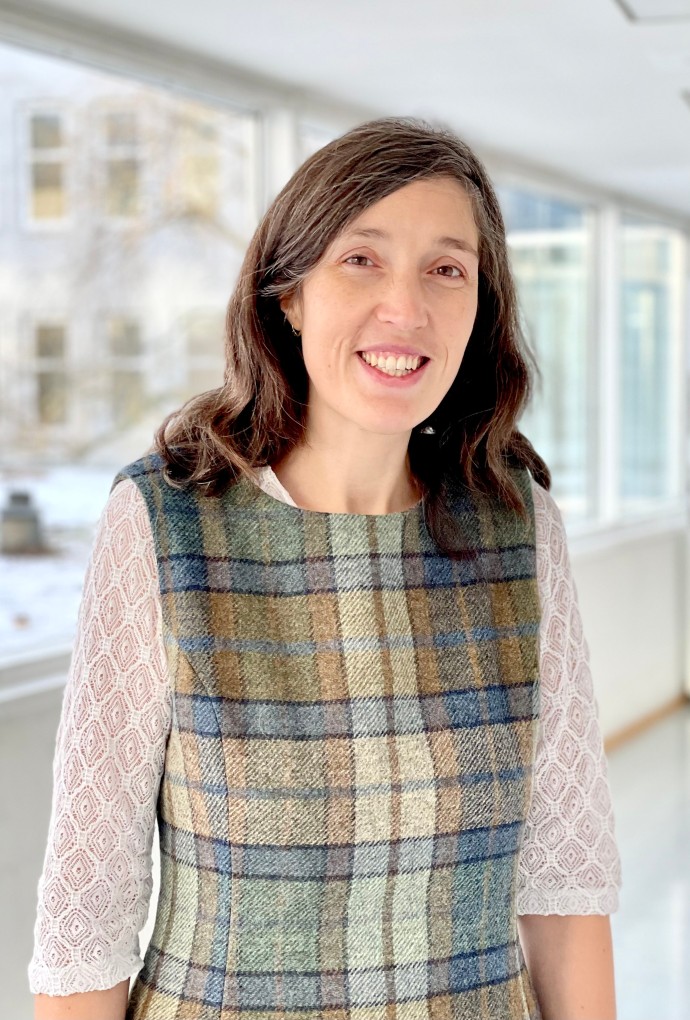
Prof. Dr. Christine Maria Greif
Fakultät 05
Room: G 3.41
Address: 80335 München, Lothstraße 34
T +49 89 1265-1584
Consultation hours
Winter semester 26/27
G 3.41 online
Fact sheet
-
Areas of expertise and responsibilities: Energy and Building Services Engineering
- Head of study area Energy and Building Services Engineering
- Head of Bachelor’s degree programme Energy and Building Services Engineering
- Head of Master's degree in Building Services Engineering
- Examination planning
- Marketing
Subject areas and responsibilities of Department 05
- 2nd deputy member of the Equal Opportunities Council
Other features:
- Member of the PZAI Doctoral Research Center – Doctoral Research Center for Applied Computer Science
- Member of the CPaB Doctoral Research Center – Center for Physical and Biomedical Engineering
- Member of the CENERGIE Institute – Research Center for Energy-Efficient Buildings and Districts
Field of teaching and research interests:
- Interdisciplinary work (programming projects, software development, data analysis and visualisation)
- Physics of Light & Astrophysics
- Building Physics & Energy Consultancy
- Python, Software Development & Data Science
- Fundamentals of Natural and Engineering Sciences & Programming
Further information
Der Kreis schließt sich
Closing the Loop: Using Synthetic Observations of Simulated Star-forming Regions to Test Observational Properties
Duration: 01.04.2023 - 31.01.2027
Show details
Prof. Dr. Christine Maria Greif is a professor of fundamental studies in natural sciences and engineering at the Hochschule Prof. Dr. Christine Maria Greif is a professor of fundamental engineering and natural sciences at Hochschule München. Prior to this, she conducted research at LMU, funded by her own research grant, in the fields of data science, radiation transport simulations of star-forming regions, and the analysis of synthetic observations, predominantly in the infrared spectrum. Prior to her appointment, she was a postdoctoral researcher at the University of St Andrews in Scotland, which followed directly on from her dissertation at the Max Planck Institute for Astronomy in Heidelberg. In addition to her expertise in astrophysics, Prof. Dr Greif has gained experience in the construction industry through her family’s joinery business. She is an expert in energy-efficient buildings for both residential and non-residential properties and is therefore a recognised energy consultant. She enjoys getting involved in interdisciplinary programming and data science projects, which are often used directly for science communication. The projects are usually implemented as open-source initiatives.
- Fundamentals of Mathematics
- Mathematics, Applications and Programming
- Building Physics
- Python Programming for Scientists and Engineers
- Scientific Key Skills
- Daylight simulation
- Python Café
Information for students
Information for students
Overview (download)
BayernMentoring is a programme for female students on all STEM degree programmes (Departments 02–09). Under the scheme, a student in a higher semester mentors a first-year student throughout their first two semesters. Further information is available at hm.edu/mentoring and in the leaflets featuring
Final assignments
Final assignments
If you are interested in a final assignment supervised by me or, perhaps, an internship, we look forward to hearing from you. Please do get in touch or contact me by email.
As part of the research projects, there are several theses for Bachelor's degrees and Master's degrees in a range of fields: civil engineering – IT – astrophysics – science communication
- Feasibility studies for retrofitting green facades or green roofs (residential and non-residential buildings)
- Raspberry Pi for Dummies: Using the Raspberry Pi for inexperienced homeowners
- Use of Raspberry Pi in the control of existing buildings (PV, heating, wallbox)
- Energy consultancy software: Programming of the BAFA Module 2 based on the iSFP
- Young Stars: Classification of Astronomical Objects
- Faculty project: From ‘witch’s cauldron’ to ‘melting pot’: the creation of a series of books in this field with the aim of communicating science, with three objectives:
- 1) Communicating complex current issues within the context of the department, e.g. the Heating Act, climate change, the ‘Pixibuch’ series on the subject areas, etc.
- 2) Integrating the expertise of Department 05 from the four subject areas within the so-called ‘melting pot’ – ranging from academic expertise to the communication of knowledge in a way that is accessible to everyone
- 3) Supporting students and providing guidance in the field of science communication, which should form part of all research, development and implementation, and which facilitates transfers of knowledge to society. Suggestions here.
Do you have an idea of your own? Please don’t hesitate to get in touch with me about it.