News
Communication for a digital and intercultural working world
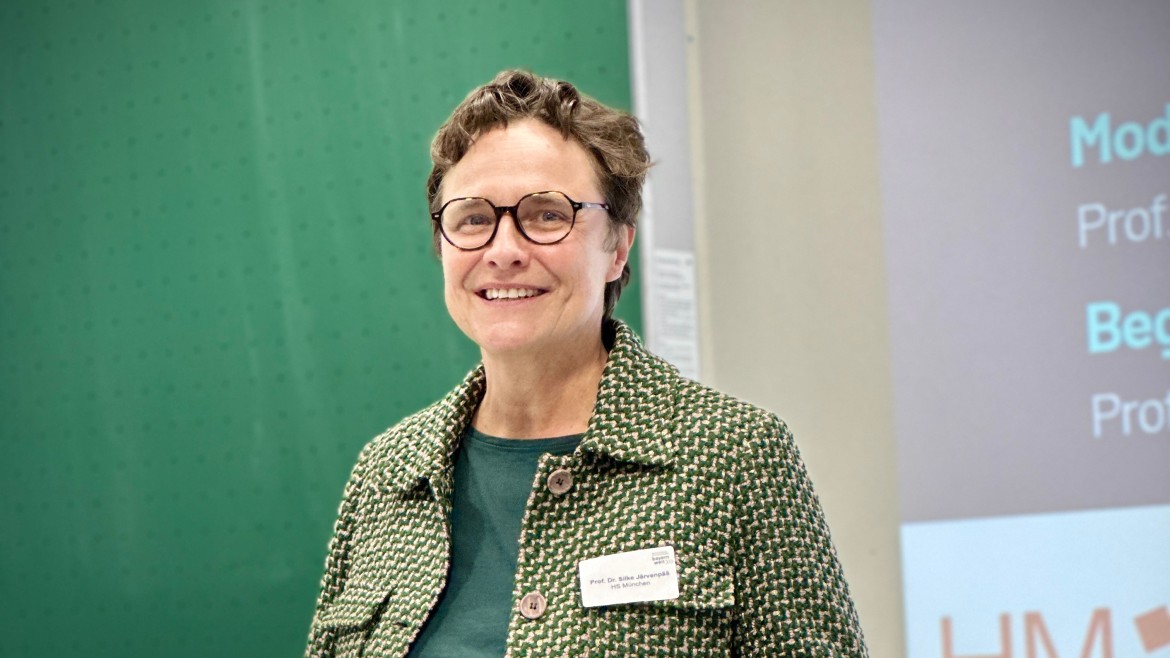
New extra-occupational master's degree programme in Dig-I-Kom (Digital and Intercultural Communication) : an interview with Prof. Dr. Silke Järvenpää, a member of the degree programme team
05/05/2026
WBZ: Professor Järvenpää, Hochschule München is set to launch a new programme. What is Dig-I-Kom all about?
Silke Järvenpää: Dig-I-Kom stands for Digital and Intercultural Communication. It is a master's degree programme that can be studied extra-occupationally. Teaching takes place in blocks, mainly at weekends.
In terms of content, the degree programme combines two fields that are now closely interlinked: intercultural communication and digital communication. We live and work in a globally interconnected world in which communication is increasingly taking place digitally, internationally and in a culturally complex manner. This requires people who can understand, analyse and professionally shape communication processes.
The degree programme therefore covers both academic fundamentals and practical skills. It focuses on theories, methods and specific practical issues: How do people communicate in digital spaces? How do cultural influences affect communication? And how can effective communication be achieved in complex social and professional contexts?
WBZ: Why is this degree programme needed at Hochschule München?
Silke Järvenpää: Hochschule München already offers degree programmes with an international focus. However, Dig-I-Kom has its own distinct focus. The primary focus is not on project management, but on the intersection of intercultural communication, digital communication and social development.
The degree programme is a further development and reorientation of the previous Master’s programme in Intercultural Communication and Cooperation. The main new features are a stronger focus on digital communication, digital media, AI, ethics and the question of how cultural identities and forms of communication are changing in digital public spheres.
WBZ: What sort of content can students expect?
Silke Järvenpää: We have structured the degree programme around several key areas. These include communication, culture and politics, digitalisation, and research methods.
Students explore cultural theories, communication theories, digital media theories and methodological approaches. These include empirical social science methods as well as interpretative approaches, hermeneutic approaches and critical discourse analysis.
It is important to us that theory and practice are brought together. That is why students also work on projects and practically-oriented issues. The timetable includes, for example, intercultural negotiation, storytelling, visualisation techniques, small-scale research projects and larger practical projects.
Towards the end of the studies, students are expected to plan a more extensive project, potentially in collaboration with companies, institutions, public authorities, research organisations or non-profit organisations. The studies culminate in the Master’s thesis.
WBZ: Are there opportunities to specialise?
Silke Järvenpää: Yes. Students can choose their areas of specialisation. One specialisation focuses more on political communication, whilst another focuses more on cultural and intercultural communication. This allows students to tailor their studies to their career interests and previous experience.
WBZ: Who might be interested in this degree programme?
Silke Järvenpää: Dig-I-Kom is aimed at professionals who work in the fields of communication, culture, international affairs, digitalisation or social mediation, or who wish to develop their careers in these areas.
The degree programme is of particular interest, for example, to people working in the public sector, local authorities, government departments, international organisations, cultural institutions, migration services, public relations, corporate communications or the non-profit sector.
Even those already working in journalism or communications can benefit from this degree programme if they wish to specifically develop their digital and intercultural skills.
WBZ: What career opportunities does Dig-I-Kom offer?
Silke Järvenpää: The range of potential career paths is wide. Graduates can work in any field where communication needs to be managed across cultural, organisational or digital boundaries.
This applies to international organisations, public bodies, businesses, cultural institutions, NGOs, educational organisations and communications departments. The degree programme is particularly relevant for roles involving the communication of complex content, bringing together diverse groups, or developing digital communication strategies.
WBZ: What role does storytelling play in the degree programme?
Silke Järvenpää: Storytelling is an important application of the fundamentals of communication studies. People respond to stories, patterns of interpretation and narratives. Anyone who designs communication professionally must understand how such narratives arise and how they have an effect.
The degree programme focuses on using storytelling in a thoughtful and responsible manner. This may be relevant, for example, to campaigns that promote intercultural understanding or teach people how to navigate digital and analogue environments.
We do not view storytelling as a manipulative technique, but rather as a method of conveying content in a way that is understandable, relatable and meaningful.
WBZ: Do fake news, manipulation and AI also play a role?
Silke Järvenpää: Yes, these topics form part of the digital component of the degree programme. They include the ethics of digital communication, the ethics of AI, disinformation and how to deal with manipulation campaigns.
It is not only important to recognise and understand such phenomena. Students should also learn how to respond to them professionally. It is therefore a question of analysis, assessment and counter-strategies.
WBZ: What qualities should applicants have for an application?
Silke Järvenpää: A completed bachelor’s degree is a prerequisite. The programme is interdisciplinary in nature and is specifically aimed at applicants from a variety of academic disciplines.
Those who have already studied communication studies, cultural studies or a related subject will have prior knowledge of the subject area. Those coming from a different background – such as engineering, public administration, business or other disciplines – will be brought up to speed on the subject matter during the first semester.
It is precisely this mix that is important for the degree programme. The students’ diverse professional and academic backgrounds enrich the discussions and projects.
WBZ: Why are you personally looking forward to this degree programme?
Silke Järvenpää: I’m looking forward to Dig-I-Kom because, in my view, the topics covered are very important. Digital and intercultural communication are key skills in many areas of the workplace.
The degree programme offers the opportunity to teach these subjects in a way that is both academically rigorous and practically-oriented. Its interdisciplinary nature is particularly valuable. It allows the expertise of the department’s professors and senior lecturers to be brought together and made accessible to working professionals.
Dig-I-Kom demonstrates the expertise available at Hochschule München and how this expertise can be translated into a range of degree programmes that are up-to-date and relevant to society.