Press release
AI steers the car through the city (Press Release 23/26)
Hochschule München takes stock of the STADT:up collaborative project on autonomous driving
25/06/2026
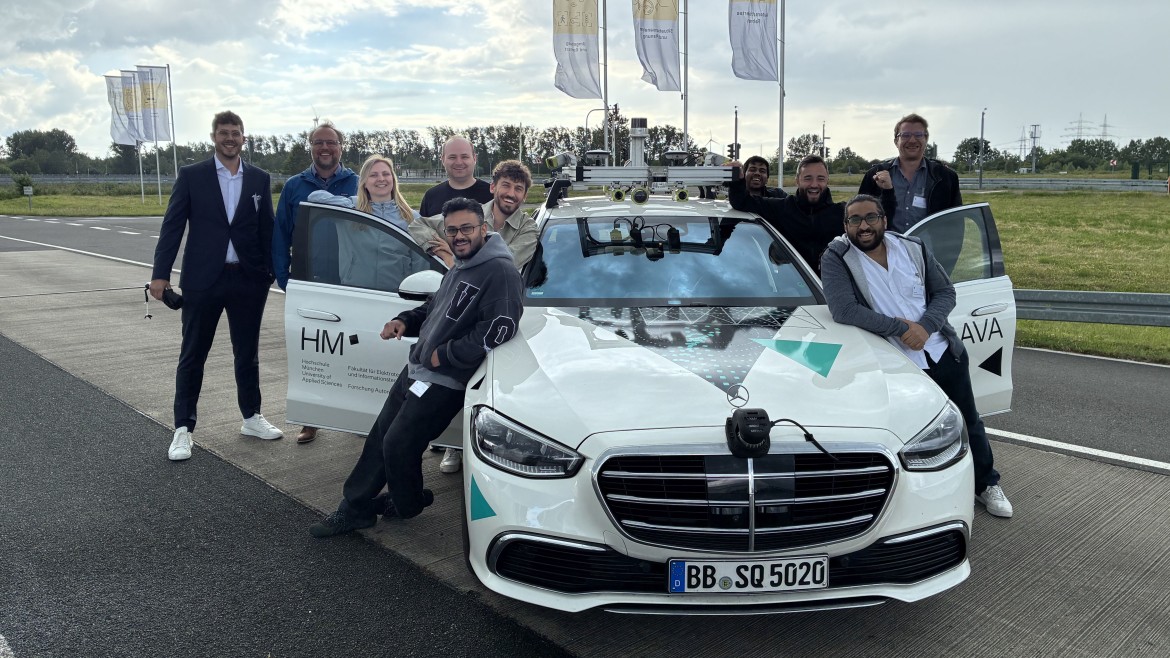
The STADT:up collaborative project held its closing event at the Aldenhoven Testing Centre. For three and a half years, 20 partners from industry and academia worked on enabling vehicles to navigate city traffic completely autonomously. Hochschule München (HM) took part with three demonstrators and provided key technologies for the AI-based detection of pedestrians and cyclists.
Traffic lights, cyclists, pedestrians: the challenge of urban traffic
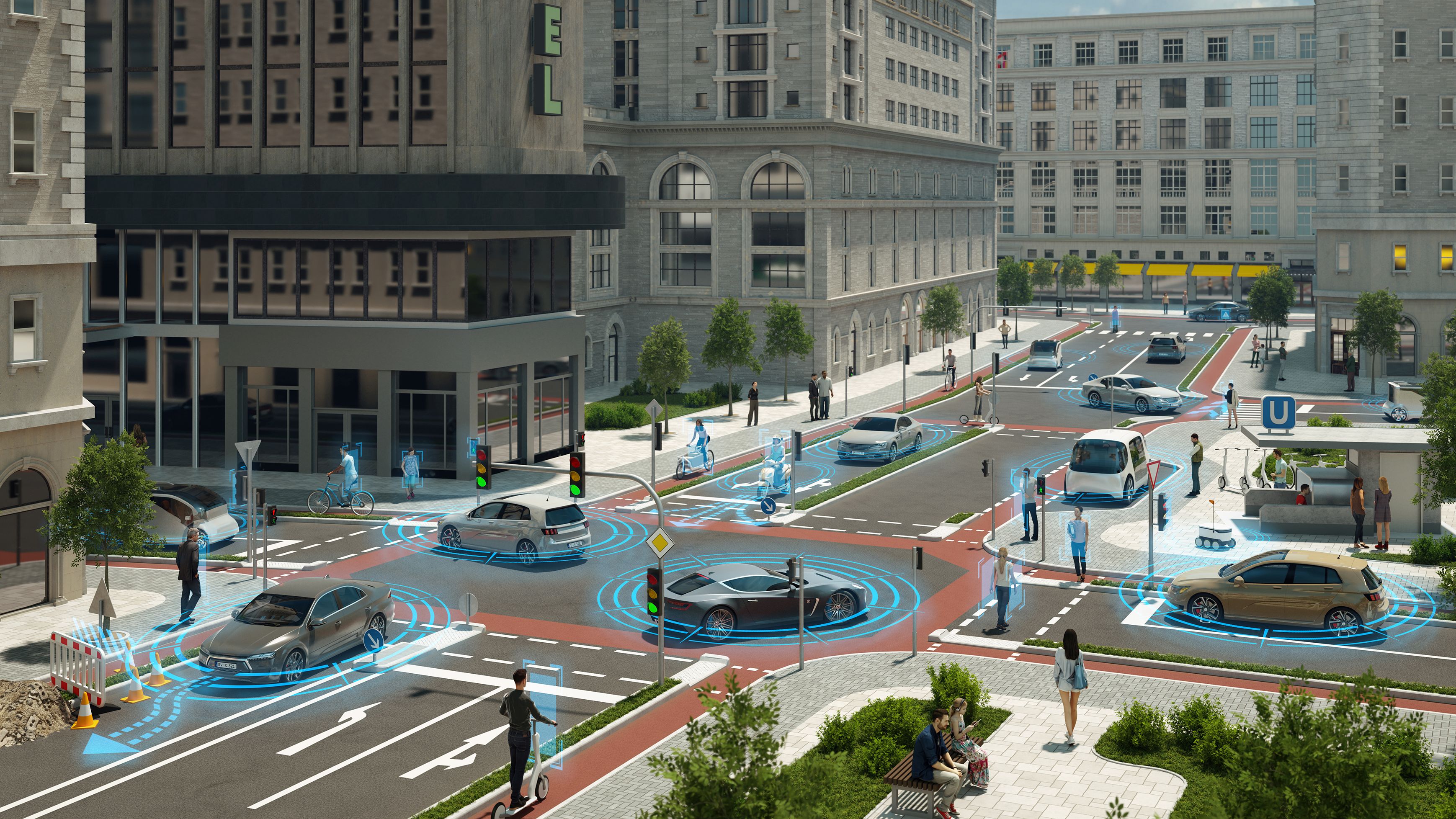
Cars have long been driving autonomously on motorways. City streets, however, are a different world altogether. Heavy traffic, unclear right-of-way rules, cyclists turning off the road, pedestrians appearing out of the blue – no two situations are the same. This is precisely where STADT:up came in: to enable fully autonomous driving in urban traffic without the need for drivers to intervene.
The Federal Ministry for Economic Affairs and Energy provided funding for the project under the ‘New Vehicle and System Technologies’ programme, totalling 62.2 million euros. The project ran for three and a half years, from January 2023 to June 2026.
At the final demonstration, HM presented three of its own developments, all of which are based on data-driven AI methods:
AVA research vehicle: The car that thinks for itself
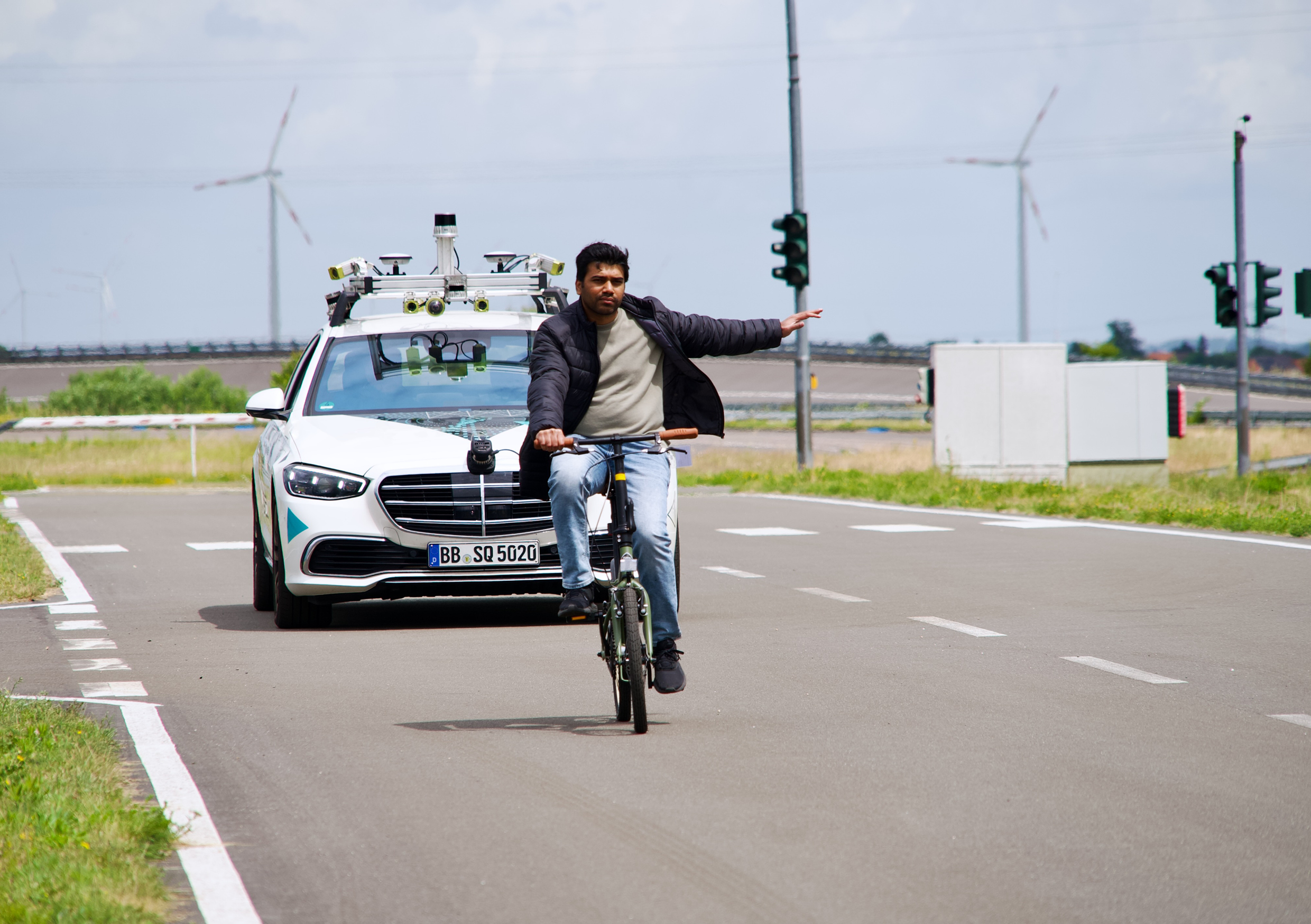
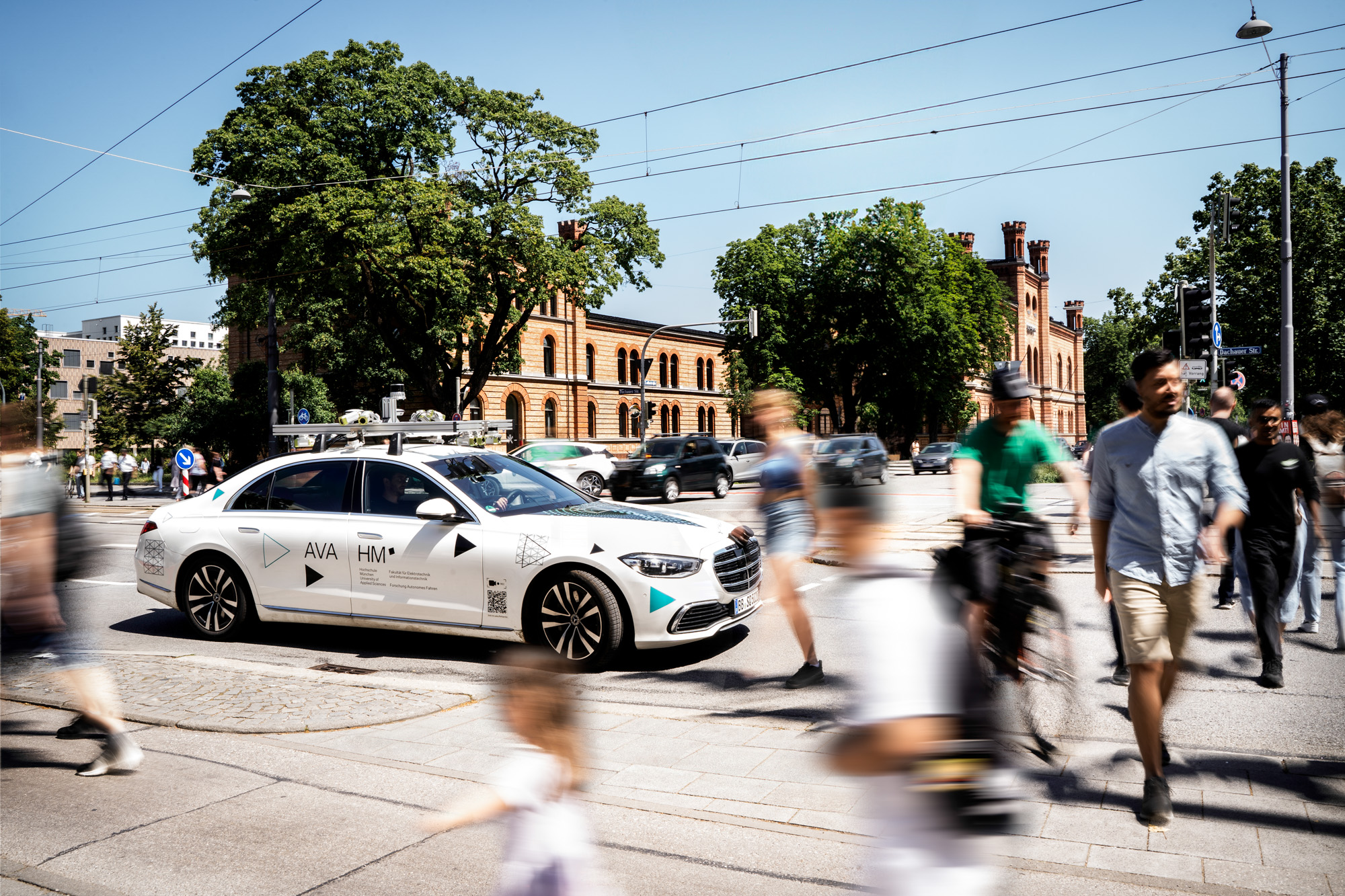
The AVA test vehicle not only detects where a pedestrian is standing – it anticipates where they are going to go next. Equipped with cameras, LiDAR and powerful computing hardware, the system processes complex traffic situations in real time. The result is a driving style that reacts early, before critical situations arise.
Virtual boundary cases: testing without taking any risks
How do you test whether an autonomous vehicle reacts when a child suddenly runs out onto the road? HM has developed a VR-based simulation environment for this purpose. Using motion capture and voice commands, test subjects control virtual pedestrians in the CARLA driving simulator – in a highly realistic manner and without any safety risks.
Focus: Data Collectors and Cooperative Perception
The FUSE-Bike provides precisely the traffic perspective that autonomous vehicles have so far lacked. Equipped with 360° LiDAR, cameras and GPS, the e-bike acts, on the one hand, as an intelligent data collector directly from the saddle. On the other hand, it facilitates cooperative perception: by sharing its live data with cars, these can literally ‘see round the corner’ and anticipate the intentions of other road users even before they have visual contact themselves.
Prof. Dr. Fabian Flohr, HM Professor of machine learning and autonomous systems, says: “Urban traffic is the toughest challenge you can throw at an autonomous vehicle. STADT:up has shown that AI-based systems are already capable of handling this complexity – provided you have the right data and ask the right questions. At the HM, we’re teaching AI to interpret urban chaos through the eyes of pedestrians and cyclists. This enables autonomous vehicles to think ahead and make the unpredictable predictable.”
About STADT:up
The STADT:up joint project (“Solutions and Technologies for Automated Driving in Town”) received funding under the “New Vehicle and System Technologies” funding programme run by the Federal Ministry for Economic Affairs and Energy. Running for three and a half years with a total budget of 62.2 million euros, STADT:up made a significant contribution to the further development of safe, user-centred and sustainable automated mobility in urban areas.
The participants included the car manufacturers CARIAD SE, Mercedes-Benz AG and Opel Automobile GmbH, as well as the supplier and technology companies Aptiv Services Deutschland GmbH, AUMOVIO SE, AVL Deutschland GmbH, DeepScenario GmbH, Ergosign GmbH, gestigon GmbH, HELLA GmbH & Co. KGaA, Robert Bosch GmbH, Valeo and ZF Friedrichshafen AG. From the field of science and research, the Federal Highway Research Institute (BASt), the German Aerospace Centre (DLR), Hochschule München, Chemnitz University of Technology, Darmstadt University of Technology and the Technical University of Munich contributed to the project as partners. We would be happy to arrange an interview with Prof. Dr. Fabian Flohr.
Contact: Ralf Kastner on T 089 1265-1922 or by email .