Press release
Organising care provision competence-oriented (PM 28/26)
An HM research team is demonstrating, at two care homes, how new statutory requirements for staffing planning in elderly care can be implemented in such a way as to ease the workload on registered nurses and care assistants – whilst ensuring that residents receive better care.
25/08/2026
Munich, 26 August 2026 – Since July 2023, a new staffing assessment tool for residential long-term care has been in force nationwide (in accordance with Section 113c of Book XI of the Social Code). This is based on the so-called Rothgang Study, which, for the first time, assesses staffing requirements on the basis of qualifications and the care levels of residents, with the aim of allocating tasks more specifically according to qualification levels. A three-year research project at the Department of Applied Social Sciences at Hochschule München (HM), in collaboration with Hilfe im Alter gGmbH of the Diakonie Munich and Upper Bavaria, investigated how this legal framework can be implemented in a way that benefits both staff members and residents. The research project was led by HM Professor Markus Witzmann; with research assistant Isabel Hölscher coordinating the project.
A competence- and relationship-oriented approach
Relationship-oriented care is at the heart of the new model, which focuses on six fundamental needs of people requiring care, based on a model developed by care scientist Mike Nolan: security, continuity, belonging, purposefulness, meaningful achievements and appreciation. Rather than allocating tasks purely on a functional basis, the model assigns each resident a dedicated nurse to act as their care coordinator. Professional responsibility for the care process (care coordination) and organisational responsibility (unit management) are clearly separated. The allocation of tasks within the team is consistently based on the qualification levels set out by Rothgang, including the tasks reserved by law for qualified nursing staff under Section 4 of the Nursing Professions Act, namely responsibility for the care process.
Trialling in two pilot facilities
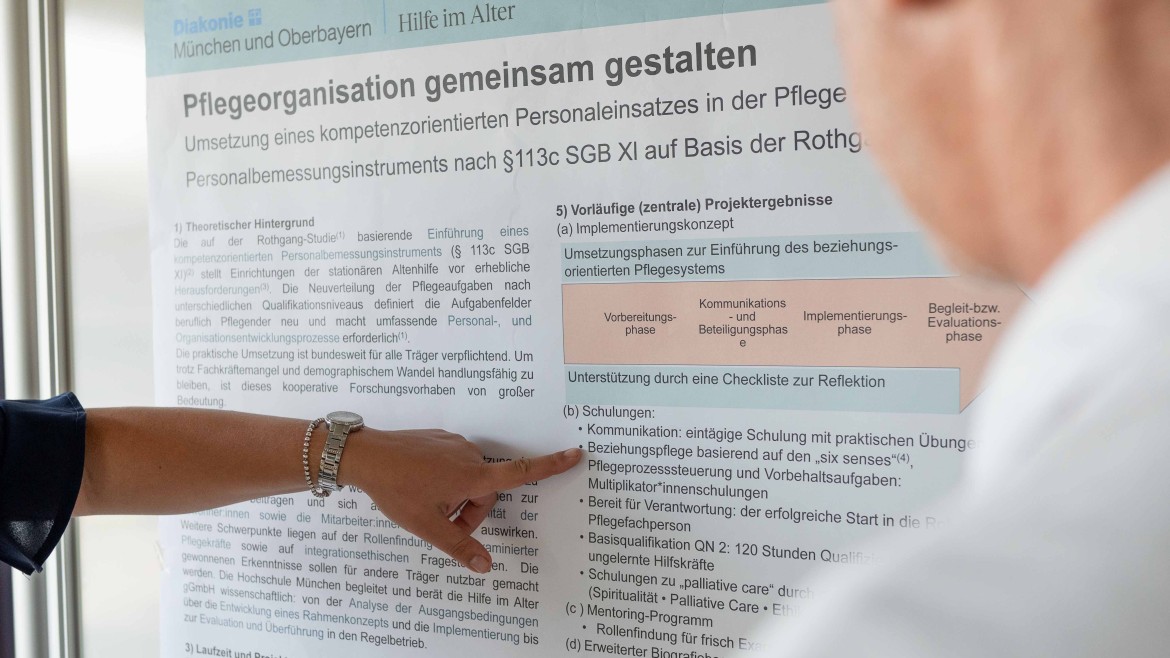
The model was tested in two Protestant care centres over four phases: an analysis of the current situation at each facility was followed by a joint kick-off meeting and the joint development of tasks, roles and service procedures with staff from all levels of qualification. In the subsequent implementation phase, the model was put to the test in practice, supported by training sessions, workshops and close supervision from senior management. The process concluded with an evaluation phase featuring reflective discussions and feedback from staff members and residents. The process was supplemented by a mentoring programme for career changers and those new to the profession, as well as a training programme for care assistants. Furthermore, palliative care structures were expanded using resident-centred values questionnaires and standardised case conferences, which identify the personal needs and wishes of residents in elderly care.
Scientific support using a mix of methods
HM provided multi-methodological support throughout all project phases. The baseline analysis included, amongst other things, an assessment of the structures, staff and resident population of the two facilities. This was followed by a participatory concept development process in which staff members at all qualification levels were actively involved. The subsequent evaluation of the implementation took into account both the staff members’ perspective and that of the residents, thereby enabling a well-founded assessment of the new care system’s impact in practice. Project coordinator Isabel Hölscher emphasises the relief brought about by the newly developed approach to qualification-centred staffing levels: “The separation of professional and organisational responsibilities takes the pressure off the teams – this allows all staff members to work efficiently within their areas of responsibility and, for example, to strengthen their relationships with residents.”
A transferable model for other facilities
: The evaluation at the two pilot facilities showed that, with appropriate support and stable operating conditions, the system leads to improvements: more time for direct contact with residents, clearer lines of responsibility and the systematic implementation of statutory requirements. “The key outcome of the project is a comprehensive, tried-and-tested implementation plan, which contains detailed job descriptions, training programmes, support strategies and structured implementation recommendations, and is available as a practical tool for organisation-wide implementation,” said Witzmann.
We would be happy to arrange an interview with HM Professor Markus Witzmann and research staff member and project coordinator Isabel Hölscher.
Contact: Constance Schölch on T 089 1265-1920 or by email.
Project
information The project “Implementation of a competence-oriented staffing approach in care within the framework of the staffing assessment tool under Section 113c of Book XI of the Social Code (SGB XI), based on the Rothgang study in collaboration with Hilfe im Alter gGmbH of the Inner Mission Munich” is funded by the Bavarian State Ministry of Health, Care and Prevention and ran from January 2023 to December 2025.
Publication
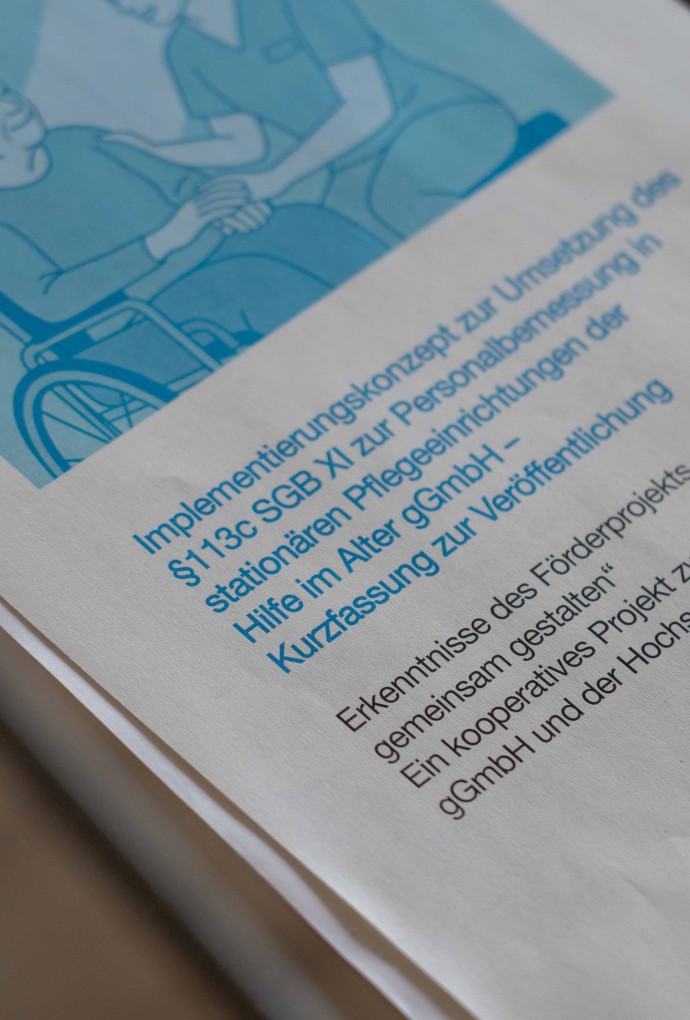
Markus Witzmann, Isabel Hölscher, Birgit Kennerknecht, Dirk Spohd. Implementation concept for the application of Section 113c of Book XI of the Social Code (SGB XI) regarding staffing levels in residential care homes operated by Hilfe im Alter gGmbH – Abstract for publication. University of Applied Sciences München, 2026
doi.org/10.60948/OPUS-1335