News
From a Master’s thesis to a government department: How scientific curiosity paved the way for the digitalisation of the emergency services
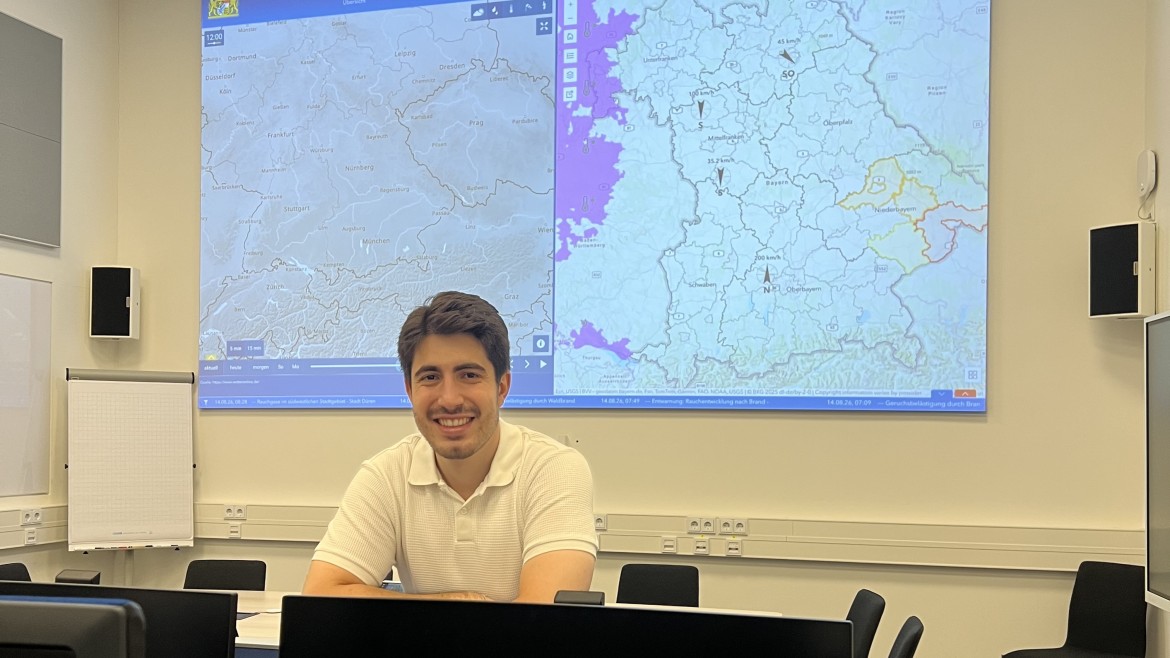
Alumni Profile: Tobias Finsterwalder (Master’s programme in Digital Technology Management)
31/08/2026
Please note that this article has been automatically translated from German.
A Master’s thesis at HM Business School led to a career leap into a field of the future: Tobias Finsterwalder, an alumnus of the Master’s programme in Digital Technology Management, is now shaping the further development of the telemedicine emergency doctor system in Bavaria.
When scientific curiosity leads to social impact
Sometimes a career path begins with an idea. For Tobias Finsterwalder, it took him straight from HM Business School to the intersection of digitalisation, healthcare and state politics.
A graduate of the Master's degree programme in Business Administration, specialising in Digital Technology Management (DTM), now works as a Technical Adviser for the Telenotarzt scheme at the Bavarian State Ministry of the Interior, Sport and Integration. In this role, he is involved in the technical and conceptual development of a system designed to bring about lasting change to emergency care in Bavaria.
He laid the foundations for this whilst studying for his Master’s degree at the HM Business School at Hochschule München. His Master’s thesis examined the factors influencing the acceptance of tele-emergency doctor technology from the perspective of users within the Straubing-Bogen emergency medical services sector. The thesis was supervised by Prof. Dr. Daniel Jan Ittstein (Department of General and Interdisciplinary Studies); the second supervisor was Prof. Dr. Eva Anderl, coordinator of the Digital Technology Management Master’s programme.
Today, Finsterwalder is working precisely on the forward-looking topic that he analysed academically back then.
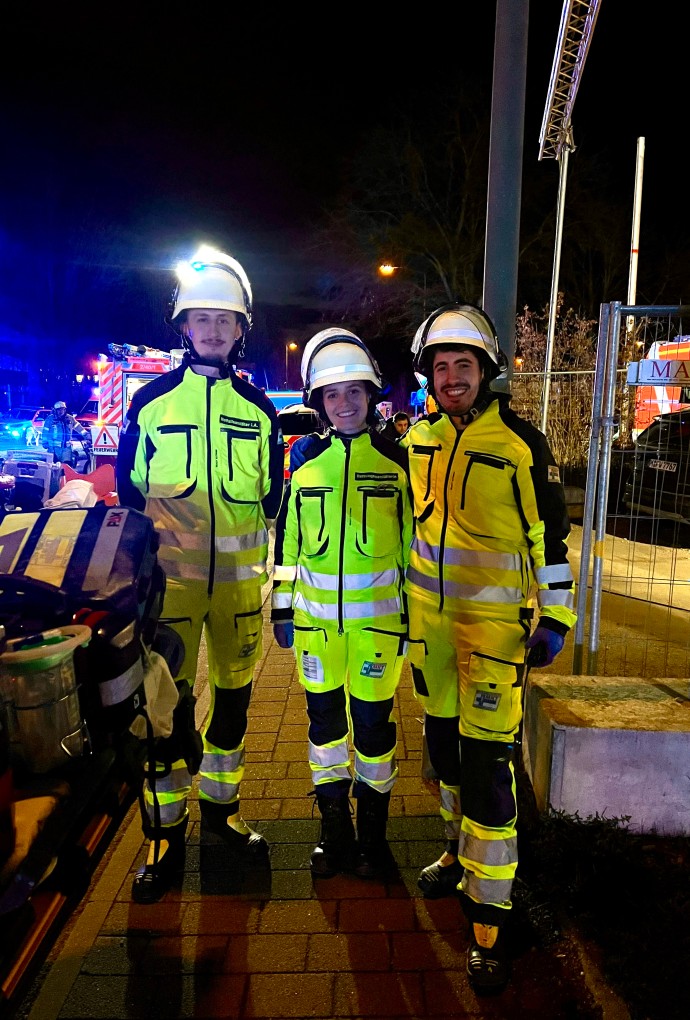
‘Two Worlds’, a theme
His choice of topic was no coincidence. Long before he wrote his Master’s thesis, Tobias Finsterwalder had been operating in ‘two worlds’: digitalisation and the emergency medical services.
He began working in the ambulance service in 2018. For a period of around seven years, he worked there primarily as a student trainee whilst studying. Even after this role came to an end, he has remained connected to the ambulance service and has been volunteering there since June 2026. At the same time, whilst studying, he took a keen interest in digital technologies and their application within complex organisations.
“This topic has brought my two worlds together perfectly. On the one hand, I studied Digital Technology Management and have always been interested in new digital technologies. On the other hand, I have been working in the emergency medical services for many years. The telemedicine system brings these two areas together,” says Finsterwalder.
However, the idea did not first arise with his final assignment. Even whilst he was still a student, Finsterwalder had been exploring issues relating to emergency care in depth. He was first inspired by the DTM course ‘Digital Technology:Leadership and Ethics’, which Prof. Ittstein ran in collaboration with the practice partner Munich Re.
“In my view, Mr Finsterwalder is one of those examples that show what can be achieved when personal passion, academic research and practical experience come together,” says Prof. Ittstein.
The professor and student then discussed various potential topics together. In the end, they settled on telemedicine technology – a field that directly linked Finsterwalder’s professional experience with the content of his degree course.
Why remote emergency medical care is a topic for the future
The telemedicine system is designed to make medical expertise available more quickly and to utilise the limited resource of emergency doctors more efficiently.
Particularly when call-out numbers are rising, journey times are long, there are staff shortages or service disruptions, this technology can help to provide medical care to patients more quickly.
For Finsterwalder, it was precisely this tangible benefit that proved decisive:
“I was fascinated by the fact that the remote emergency doctor is not an end in itself when it comes to digitalisation. The technology is designed to solve very specific problems: making medical expertise available more quickly and deploying the scarce resource of emergency doctors in a more targeted manner. This can make a real difference to patients’ health, particularly in rural areas.”
Whilst many studies focus on the technical functionality of such systems, he was interested in a different perspective: how do those who work with the technology on a daily basis perceive it?
What determines the success or failure of digitalisation
His Master’s thesis therefore focused not on technical feasibility, but on the question of acceptance.
To this end, Finsterwalder conducted qualitative interviews with paramedics and emergency doctors working remotely. The aim was to identify which factors encourage or hinder its use.
One realisation surprised him in particular:
“What surprised me most was how differently the two professional groups view the same system. Although they are all pursuing the same goal (the best possible patient care), their experiences, expectations and concerns differ, in some cases significantly.”
The study showed that technological innovations require far more than just functional software and reliable infrastructure. Trust, an understanding of roles, organisational support, communication and technical reliability have a significant influence on acceptance.
“The introduction of new technologies is far more than just a technical task. You have to get the people who will be working with them on board right from the start. It is precisely this acceptance that ultimately determines whether an innovation is successful.”
For Prof. Eva Anderl, this work exemplifies what the Digital Technology Management Master’s programme is all about:
“Digitalisation only realises its full potential when technology, organisation and people are considered as a whole. It is precisely this holistic perspective that Tobias Finsterwalder has impressively demonstrated in his Master’s thesis.”
When the research suddenly turned out to match the job advert
Shortly after completing his Master’s thesis, a special opportunity arose.
Just as Finsterwalder had completed his work, a post became available at the Bavarian Ministry of the Interior dealing with the remote emergency doctor system.
“The post at the Home Office became vacant just as I was finishing my Master’s thesis. That was certainly a stroke of luck. The decisive factor, however, was that, thanks to my practical experience in the emergency services and my in-depth academic study of the subject, I already had a thorough understanding of the project.”
For him, one thing is clear: without his Master’s thesis, this step would hardly have been possible.
“My Master’s thesis was certainly an important, perhaps even the most important, building block. It demonstrated that I had engaged deeply with the subject and that I understand both the technical and organisational aspects of the telemedicine system. At the same time, I am now working on the very project that I researched academically back then.”
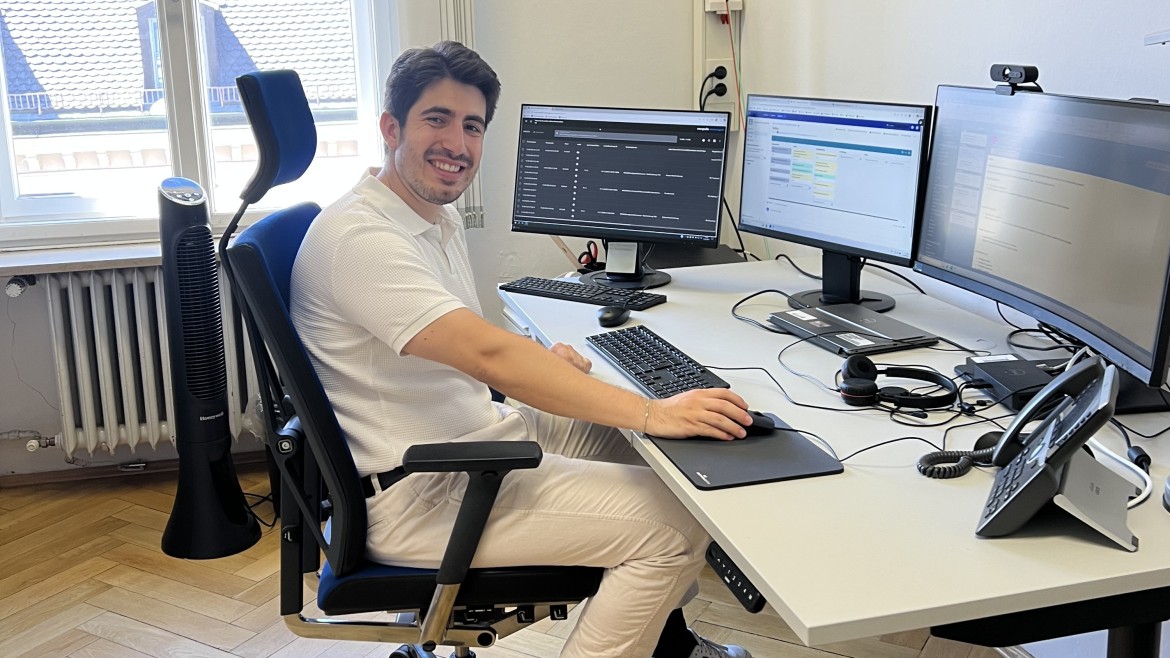
Today: Measuring quality, improving systems, shaping Bavaria
In his current role, Finsterwalder deals with strategic issues relating to the telemedicine emergency service in Bavaria.
This involves technical development, the implementation of new requirements, collaboration with emergency services organisations, health insurance funds and system service providers, as well as quality management.
One of our current priorities is the development of objective quality indicators.
“When I took on the role, one of the main focuses of my work was the development of standardised quality parameters, reliable key performance indicators and analyses. On this basis, targeted measures for the continuous improvement of the system can be derived from the data collected.”
The academic insights gained from his Master’s thesis continue to guide him to this day.
“In fact, I draw on the insights from my work almost every day. The areas of conflict I’ve identified and the resulting recommendations for action help me to better contextualise technical and organisational decisions.”
How my degree contributed to this
In addition to specialist knowledge, Finsterwalder regards the methodological skills acquired during his studies as a key factor for success.
Communication, stakeholder management and data analysis are now among his most important tools.
“In projects involving many stakeholders, technical knowledge alone is not enough. You have to understand different interests, bring them together and develop viable solutions based on them. It is precisely these abilities that were emphasised during my degree and which I draw on every day.”
For Prof. Ittstein, Finsterwalder’s career path is a prime example of the impact of a practice-oriented degree programme:
“Behind many final assignments and study programmes lie stories that show how an idea, a project or a Master’s thesis can lead to professional opportunities, innovations or even entirely new careers. It is stories like these that define HM.”
A word of advice for today’s students
Looking back, Tobias Finsterwalder has one piece of advice in particular for students who are about to start their final assignment:
“Choose a topic that you’re really passionate about. Ideally, one that you already have a personal connection to. A final assignment takes many months to complete, and genuine interest makes a huge difference.”
It is precisely this personal connection that has shaped his own path. A personal interest and a research question from his Master’s degree developed into specialist expertise. Academic research led to a career opportunity. And a final assignment became a contribution to the further development of emergency care in Bavaria.
A story that shows how curiosity, commitment and a practically-oriented approach can lead to real social impact.