Press release
Glowing signals in the rainforest (Press Release 29/26)
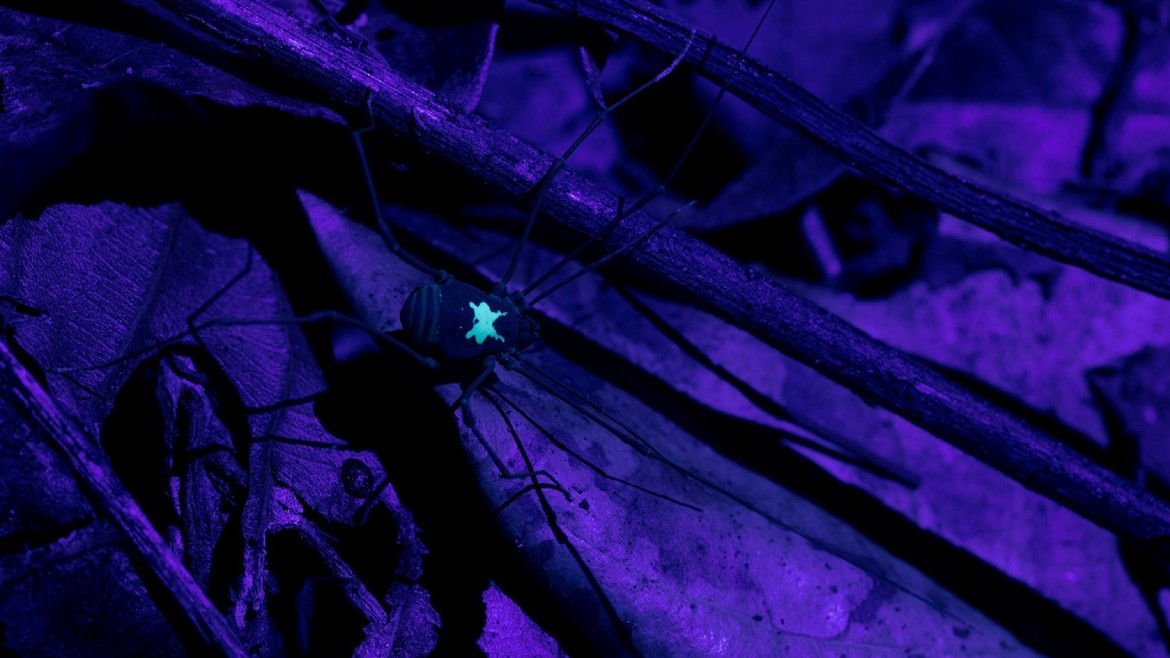
A research team from Hochschule München (HM), the Bavarian State Collections of Natural History (SNSB) and LMU Munich has investigated why harvestmen fluoresce in the rainforest. The findings provide insights into how animals use visual signals for species recognition.
02/09/2026
Munich, 2 September 2026 – In Peru’s dense rainforest, harvestmen display a striking natural phenomenon: they glow. A research team from Hochschule München (HM), the Bavarian State Collections of Natural History (SNSB) and LMU Munich has discovered several species of harvestmen during night-time excursions whose backs fluoresce a bluish-green colour in dim light. The findings were published in the journal *Scientific Reports* and suggest that the glow may help the animals to recognise other species.
Light conditions in the rainforest investigated
HM Professor Martina Schwager made a key contribution to the study. Using fluorescence spectroscopy, she investigated how light interacts with the body structures of harvestmen. Put simply, this analytical light microscopy technique measures which light causes a structure to fluoresce and which light it subsequently emits. To this end, Schwager first analysed the natural lighting conditions in the animals’ habitat – that is, moonlight and twilight under the specific conditions of the tropical rainforest near the equator. She then investigated which components of this light trigger the fluorescence of the characteristic patterns on their backs.
Perfectly adapted to its habitat
The results show that it is precisely the light spectra found in the rainforest that stimulate the harvestmen’s glow most effectively. The animals are mainly active at dusk and at night. Furthermore, Schwager was able to demonstrate that the multi-layered structure of their backs enhances the fluorescence, in a similar way to technical optical materials. Further investigations suggest that the glow is clearly visible to the harvestmen themselves.
Communication in the Dark
The research team suspects that the fluorescent patterns fulfil an important biological function. This could enable harvestmen to recognise one another even in poor lighting conditions – a crucial advantage when seeking a mate, as the animals are mainly active at dusk and at night.
The phenomenon of biofluorescence is widespread in the animal kingdom, but its function often remains unclear. This latest study now provides concrete evidence of how such signals can contribute to communication within a species.
Prof. Dr. Martina Schwager
Schwager is a Professor of physical chemistry at HM and heads the General Chemistry Laboratories within the Department of Applied Sciences and Mechatronics.
We would be happy to arrange an interview with Prof. Dr Martina Schwager.
Contact: Lisa Miethke on T 089 1265-1929 or by email .
Publications
Friedrich, S., Schwager, M., Heß, M., Glaw, F. & Lehmann, T. Evidence for fluorescence-supported species recognition in syntopic harvestmen. Sci Rep 16, 2631 (2026). https://doi.org/10.1038/s41598-026-36335-2