Press release
Affordable high-tech orthosis for children (Press Release 34/26)
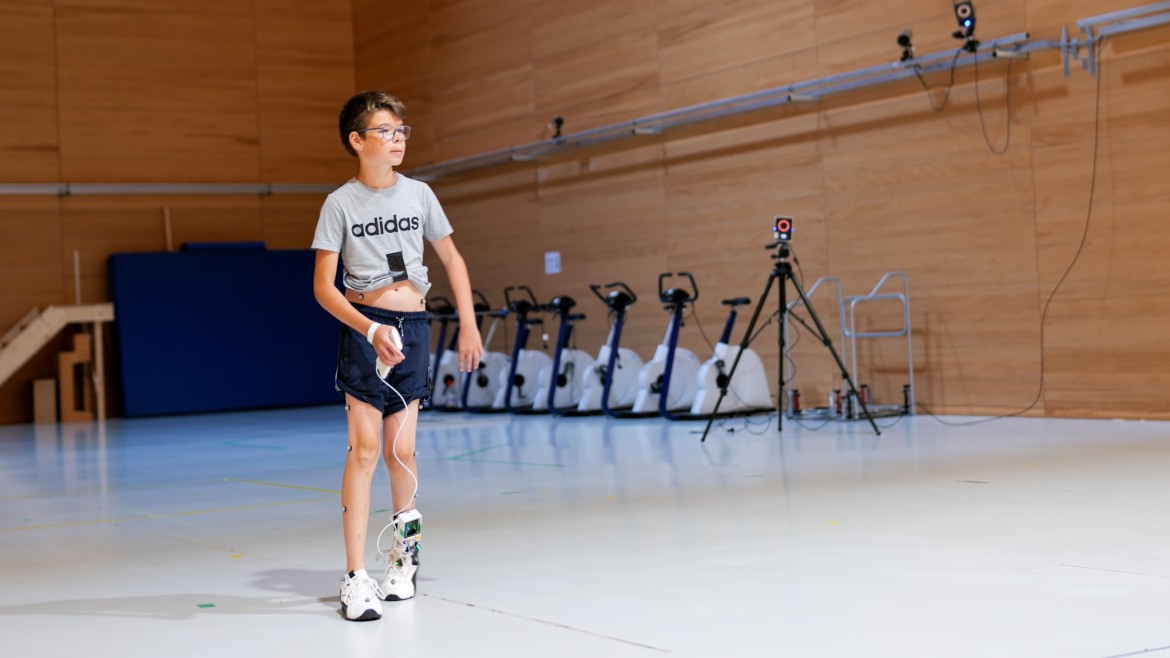
Children with walking difficulties often face a double challenge in everyday life: as well as physical limitations, many also experience social exclusion because their gait is conspicuous. A research team at Hochschule München (HM) is developing a cost-effective, customisable orthosis produced using a 3D printer to address this issue.
23/09/2026
Munich, 23 September 2026 – Children who suffer from foot drop as a result of an illness or an accident are unable to lift their forefoot properly when walking. This results in a noticeable gait, which is often more distressing for children than the physical limitation itself, as it frequently leads to them being teased and excluded. However, the development and manufacture of bespoke orthoses for children are scarcely economically viable, as the market for them is small and highly specialised. To bridge the resulting gap in care provision, a research team from the Department of Applied Sciences and Mechatronics at Hochschule München (HM) has developed a solution.
Cost-effective and bespoke orthosis manufacture as a key objective
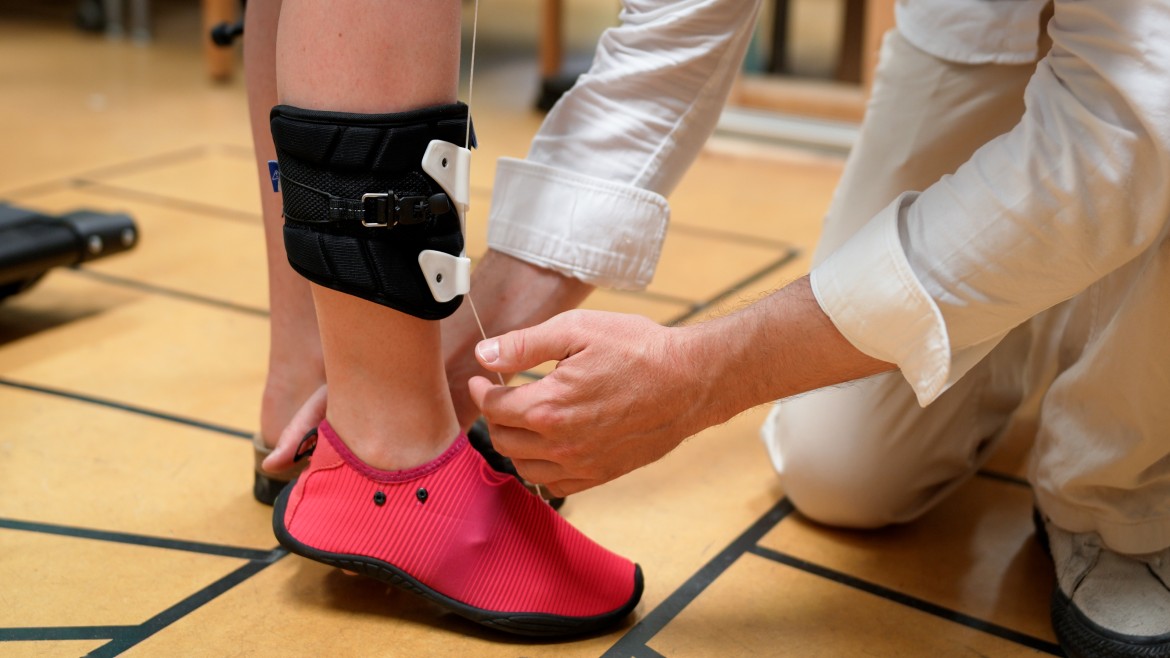
The aim of the KORA research project (Cost-effective active orthosis for the rehabilitation and analysis of movement disorders in children) is to develop a cost-effective and customisable orthosis for children with foot drop. “We have achieved this through a modular design combined with 3D printing and textile electronics. This means that the various components of the orthosis, such as the leg splint or the insole, can be individually adapted or easily manufactured,” says Project Manager and HM Professor of Design Engineering, Ulrich Wagner. To this end, data is collected via a sensor insole whilst the child is walking and analysed using a machine-learning model. The system is complemented by two apps: one designed to motivate children to use the orthosis for rehabilitation purposes through playful elements, and another intended to assist medical professionals with data analysis.
3D printing and embroidery technology as key technologies
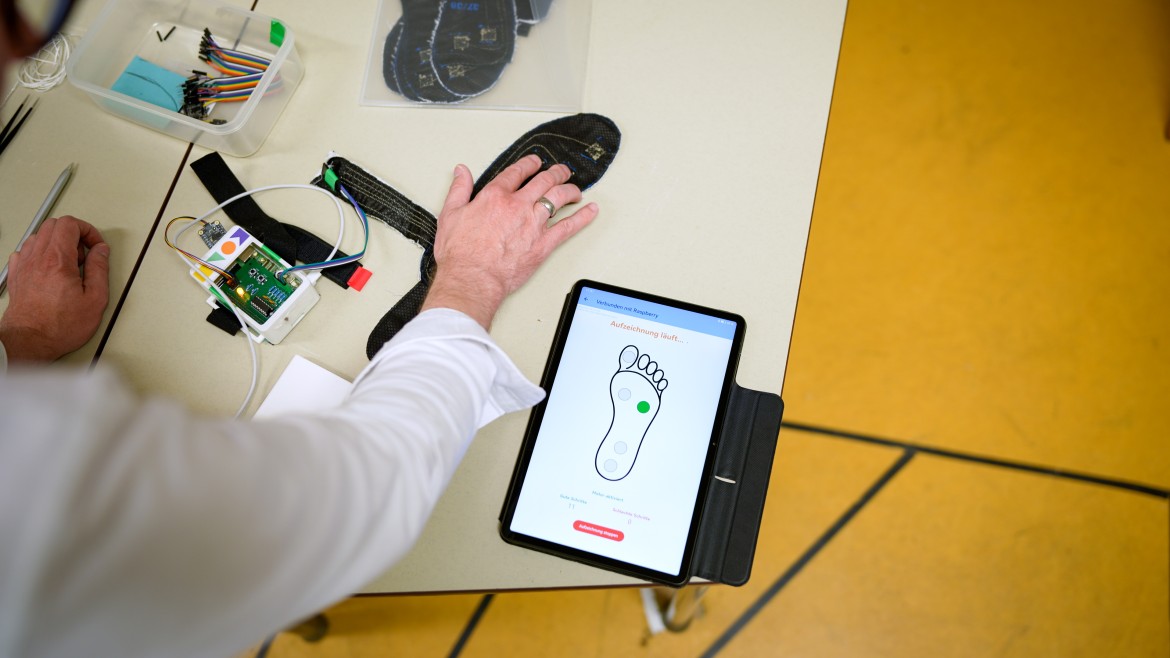
At the heart of the orthosis is a 3D-printed, customisable support element that is discreetly attached to the lower leg. Via a custom-made insole featuring embroidered, conductive yarn, a single-board computer continuously measures what happens to the foot whilst walking. An additional motion sensor detects the swing phase of the stride. Using this data, the system is designed to determine the appropriate moment for power assistance in real time and transmit this to the forefoot via a motor. “The data is continuously analysed using a specially trained machine-learning model. With the training data collected so far, we are currently achieving an accuracy of over 98 per cent in gait phase recognition within 125 ms,” explains Wagner.
Two apps support the use of orthoses
The use of the orthosis is supported by two specially developed apps. One is used for scientific evaluation: the pressure sensor data collected via the insole is transmitted to a microcomputer and analysed in real time using a machine-learning model. This enables a distinction to be made between normal and abnormal movement patterns, for example when walking in a straight line or round a bend, when changing direction or when climbing stairs. The established instrumental 3D gait analysis (3DGA) serves as a reference, with the sole’s measurements being compared against its results. Research is also being conducted into the extent to which the number of motion sensors attached to the foot, lower leg and thigh can be reduced without significantly compromising the accuracy of the analysis.
The second app is aimed at the children themselves. It makes use of gamification – that is, playful feedback based on the movements performed – combined with sensor technology. “A graduate from the Department of Design provided us with significant support in the conception and design of the games. The children control mini-games through the way they walk and, for example, with every step rated as ‘good’, they feed a dinosaur, sneak up on a cat or send a balloon on its way,” says Wagner. The aim of the app is to increase motivation to carry out rehabilitation exercises.
Sensor technology passes practical test
The team checked whether the sensor technology they had developed themselves provided reliable data by comparing it with the so-called ‘gold standard’ – a 3D gait analysis, which is regarded as the established reference method in hospitals and motion analysis laboratories. This involves recording the sequence of movements with high precision using special markers attached to the entire lower body. “The procedure is very labour-intensive and therefore expensive, but it was considered an important step in testing our system. We measured gait patterns using both systems simultaneously and compared the different phases of the gait,” explains Wagner. The test yielded a successful result for the team: it confirmed that precise gait analysis data can also be obtained outside specialised motion analysis laboratories – an important prerequisite for children to be able to complete their training at home in future. Further development steps are now required before a market-ready solution can be achieved. The team is aiming for a commercial launch.
We would be happy to arrange an interview with HM Professor Ulrich Wagner.
Contact: Constance Schölch on T 089 1265-1920 or by email .
Project information
The project “KORA – Cost-effective active orthosis for the rehabilitation and analysis of movement disorders in children” is funded as part of the Open Photonik Pro programme run by the Federal Ministry of Research, Technology and Space (BMFTR) and will run from April 2021 to October 2026.