News
New HM President Sonja Munz
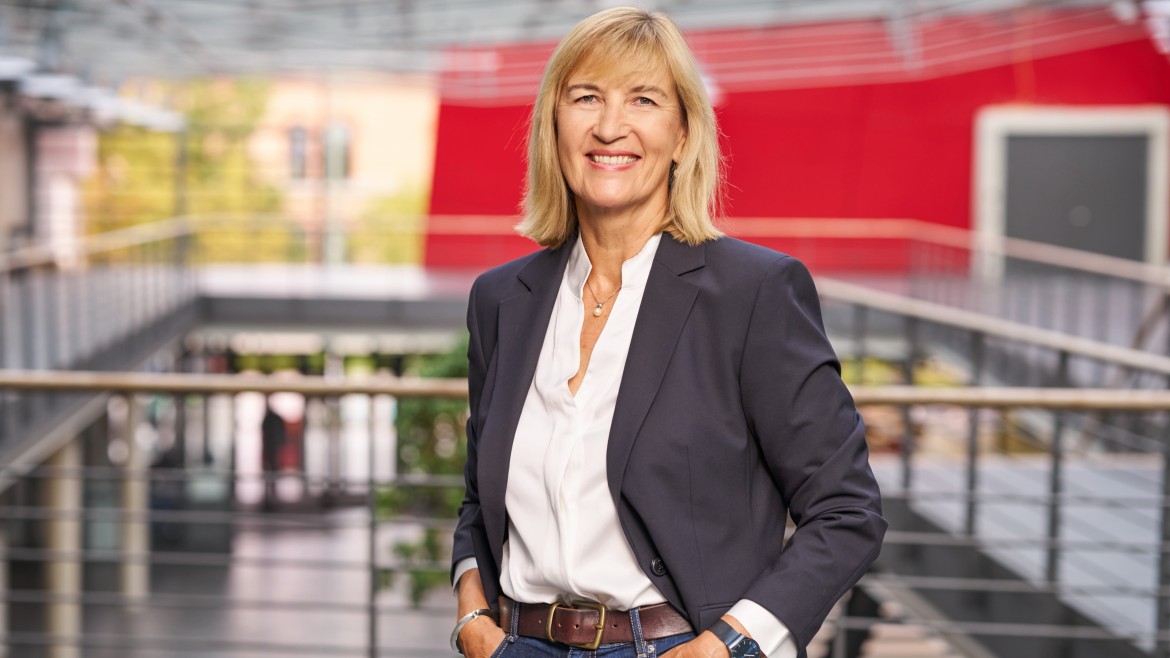
Do, measure, decide again
29/09/2026
When she commits to something, she knows why. This is the message conveyed by Sonja Munz, the new President of Hochschule München. She has already explored the world of higher education and our society in her roles as a researcher, HM Professor and Dean of the Department of Tourism, as well as Vice-President for Research. As the new President, she is the decision-maker at HM and advocates for clear objectives, but also for a culture of learning from mistakes.
Get started
Right from the start of her time at university, it all clicked: “What I felt on day one, when I took up my professorship, was the practical aspect: simply being right in the thick of it, suddenly solving problems for businesses and guiding students through the process.” This hands-on approach fits in with Munz’s philosophy: “I think it’s nonsense to say you always have to have a plan. What’s important is the confidence that you can achieve what you set out to do. But you also just have to get on with it.”
Initially, she set her sights on a career in social work and spent a year working with young offenders as part of a voluntary social service programme. Her conclusion: “This needs to be tackled at a more fundamental level!” She then went on to study sociology at Ludwig Maximilian University in Munich, and later economics, so that she could not only analyse social and labour market issues but also find strategies to resolve them. What now seems like a logical sequence of events was in fact the result of her principle of trying things out, evaluating them and making new decisions: “I can always make a change, alter my plans – we need to get back to embracing a culture of learning from mistakes.”
Versatile and decisive
Munz is also keen to try new things when it comes to her hobbies: she used to ride a motorbike from time to time to clear her head; these days, she goes hiking in the Allgäu. She is also trying out life in ‘her little village’ right in the heart of Munich – a participatively run housing co-operative, complete with meetings and social get-togethers after work.
For Munz, however, a willingness to experiment does not mean acting haphazardly. The researcher makes her decisions thoughtfully: defining objectives, measuring success, and judging on the basis of facts. It was in this spirit that, as Vice-President, she also developed the HM research institutes. Her credo: “At the end of the day, someone has to make a decision. Ideally, I want to inspire people to achieve certain things. That is why I am in favour of defining and measuring objectives; everyone can then use these as a guide.”
HM’s contribution to innovation and competitiveness
Munz currently regards the economic situation as the greatest challenge facing society and HM. “In my view, as a university, we must play our part in fostering innovation and competitiveness in Germany,” says the President. For her, this encompasses not only start-ups, but also contract research, continuing professional development for businesses, dual study programmes and the training of tomorrow’s skilled workers. “It is only when we have brought social and technical innovations to the economy and society that we will have truly capitalised on HM’s knowledge.”
Attitude: Tolerating contradictions
As well as climate change, sustainability and social issues, Munz is currently particularly concerned about the threat to democracy and the radicalisation of society. Democracy can also be promoted by setting an example – for instance, through a willingness to compromise. Rather than relying on an ‘ethics of conviction’ and the confrontational imposition of her own values, she favours an ‘ethics of responsibility’: “I want to implement things in a way that is responsible towards the majority of people. This often involves compromise, and sometimes even going against one’s own convictions. But one must take this step in order to be able to act at all in a world that is always full of contradictions.”
Her assessment of her former field of research – gender equality in the labour market – is a bitter one: “As early as the 1960s, the analysis in the literature stated: few women in senior management, low female labour force participation, high rate of part-time work. To this day, improvements have been in the per mille range.” Another reason for her candidacy was to act as a role model for women herself. She had positive role models at home: her mother and father ran the family business on an equal footing: “For me, it was rather astonishing to realise, out in the wider world, that this isn’t the norm.”
And how does the new HM President switch off from the challenges and contradictions of the world? “There’s almost nothing more relaxing than starting up the tractor and picking apples in the orchard meadows on a sunny late-summer’s day. It’s extremely meditative.”
Christiane Taddigs-Hirsch