Press release
Research team makes sustainability in tourism measurable (Press Release 39/26)

An HM research team has developed key performance indicators that enable tourism regions to monitor their sustainability progress in a standardised way
27/10/2026
Munich, 27 October 2026 – The success of a tourism region is often assessed on the basis of economic indicators such as visitor arrivals, overnight stays or turnover. However, this says little about the impact that tourism has on the environment, the local population or the quality of life in the area. In the research project ‘Measuring, communicating and valuing sustainability in tourism: a set of key performance indicators for tourism in Germany’, a standardised measurement system was therefore developed that also takes into account the environmental, social and management-related aspects of tourism regions in Germany. HM Professor Marius Mayer from the Department of Tourism was involved in the project.
A basis for assessing tourism in terms of sustainability as well
The indicators developed as part of the research project broaden the perspective on the development of tourism regions. In addition to economic aspects, they take into account, for the first time, the local population’s perceptions, the quality of life in the area, and greenhouse gas emissions from journeys to and from the destination. High tourist demand alone is therefore not sufficient to provide a comprehensive description of a destination’s development. The key performance indicators are intended to create a common data foundation on the basis of which destinations can monitor developments, review strategies, evaluate measures and identify areas where action is needed.
Nine key indicators for sustainable tourism
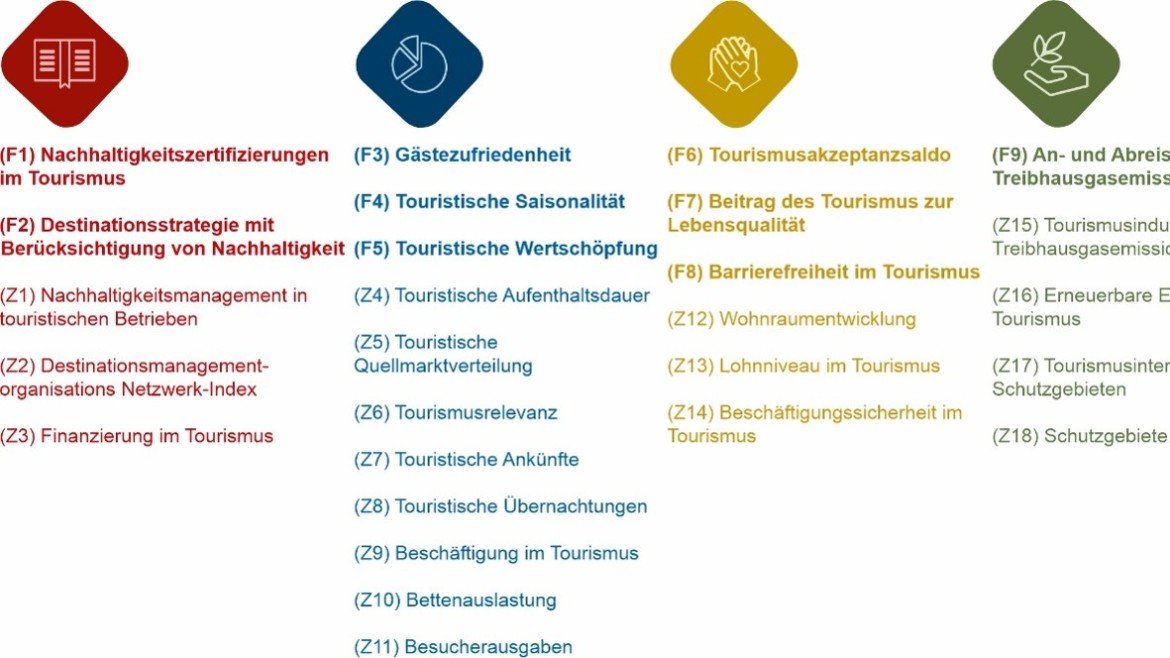
The newly developed measurement system consists of nine so-called ‘key performance indicators’. “These measurable indicators can be used, for example, to assess the role sustainability plays in the strategies of individual destinations, the proportion of businesses holding sustainability certifications, the level of acceptance of tourism amongst the local population, or the greenhouse gas emissions generated by guests’ journeys to and from the destination,” explains Marius Mayer, HM Professor of Sustainability and Destination Development. The nine key indicators are:
- Sustainability certifications in tourism
- A destination strategy that takes sustainability considerations into account
- Guest satisfaction
- Seasonal fluctuations in tourism
- Value added from tourism
- Tourism acceptance balance
- The contribution of tourism to quality of life
- Accessibility in tourism
- Greenhouse gas emissions associated with travel to and from the venue
In addition, the set contains 18 supplementary indicators that reflect regional characteristics, more in-depth issues and more complex areas of data collection.
Six regions are testing its practical applicability
The key performance indicators are the result of a multi-stage process. The project team first analysed eight national and international indicator systems comprising a total of 250 indicators. In addition, it conducted a survey of certified German tourism destinations regarding the relevance, informative value and feasibility of collecting various key figures. Key factors in the selection process included their significance for sustainable tourism development, the availability of suitable data, comparability and the effort required to collect the data.
Together with an advisory board comprising regional tourism organisations and other stakeholders from the fields of practice and academia, the project team then finalised the set of key performance indicators. The applicability of the selected indicators under different conditions was subsequently tested in six pilot destinations. The organisations involved were Deutsche Bodensee Tourismus GmbH, Tourismus NRW, Ostseefjord Schlei GmbH, Potsdam Marketing und Service GmbH, Spessart Tourismus und Marketing and the Mecklenburg-Vorpommern Tourism Association. “These pilot destinations reflect a variety of geographical, structural and organisational contexts, including urban and rural settings, coastal and inland areas, as well as destinations with varying levels of Human Resources and data resources,” explains Project Coordinator Sven Wolf from the German Tourism Association (DTV).
Key figures alone do not ensure sustainability
This set of key performance indicators provides, for the first time, a nationally harmonised framework enabling destinations to document their sustainability progress in a comparable manner over time. The actual nationwide data collection across all destination levels has yet to take place, as do issues relating to funding and a possible central platform for presenting the figures. “Key performance indicators alone do not create sustainability,” says Mayer, “but as the indicators were developed and identified as relevant by the destinations themselves as part of a bottom-up process, the expectation is that the set of indicators will now be applied in destination practice and, as a monitoring and benchmarking tool, will contribute to evidence-based improvements in sustainability in German destinations”.
We would be happy to arrange an interview with HM Professor Marius Mayer.
Contact: Constance Schölch on T 089 1265-1920 or by email.
Project
information The project ‘Measuring, communicating and valuing sustainability in tourism: a set of key performance indicators for tourism in Germany’ was funded by the Federal Ministry for Economic Affairs and Energy (BMWE) as part of the ‘LIFT Transformation’ programme, coordinated by the German Tourism Association (DTV) and carried out in cooperation with reCET (Prof. Dr. Martin Balas), TourCert and the HM (Department of Tourism). It ran from July 2024 to December 2025.
Publication
Click here for the project report.