Promoting Women at the Graduate School
Find out more about PhD scholarships for women and the meant4science mentoring programme for female doctoral candidates and research assistants at HM.
PhD scholarships for women
To support female researchers at the early stages of their careers, the State Conference of Women’s Representatives awards doctoral scholarships to female graduates of universities of applied sciences and to women with relevant professional experience.
Further information: Website of the State Conference of Women’s Representatives
Contact: University Women’s Representative
meant4science Mentoring Programme

The meant4science mentoring programme is aimed at female doctoral candidates and research assistants (and, in certain cases, female Master’s students who are prospective doctoral candidates) at Hochschule München, regardless of their field of study.
Through the meant4science programme, Hochschule München aims to support highly qualified female high-potential candidates on their personal career paths. The mentoring programme provides guidance throughout the decision-making process regarding future career paths, whether within or outside academia, thereby supporting the mentees’ individual career planning.
Mentoring is an informal supportive relationship that focuses on the transfer of experience and personal exchange between individuals at different stages of their careers. As part of the mentoring process, a mentee is supported by an experienced individual (mentor) over a specific period of time in their professional and personal development. The focus is on the transfer of both formal and informal knowledge, as well as mutual networking and the opportunity to participate in the mentor’s scientific or business community.
A mentoring relationship is characterised by the fact that it is entered into voluntarily, that everything discussed remains confidential, and that the two mentoring partners are not in a relationship of dependency on one another.
Whilst mentees primarily broaden their knowledge of career paths and planning, work-life balance and the rules of the academic system and the business world, mentors develop their advisory and leadership skills and gain important insights into the situation faced by early-career female researchers.
Mentees:
Benefit from your mentor’s experience, build a strong support network, plan your career and develop personally.
Face-to-face meetings with your mentor provide an insight into the career path and day-to-day working life of an experienced professional, and thus also into a potential career field. This gives you the opportunity to work out for yourself whether a career in academia – for example, as a university lecturer – is an option for you, or whether you would prefer to work outside academia and/or perhaps even set up your own business.
Opportunities for mentees:
- Mentors stand in solidarity with their mentees, acting as role models and reflection partners, for example in situations involving decision-making or major changes.
- You will gain an understanding of the formal and implicit structures, processes and rules within your mentor’s professional field.
- Through a series of high-calibre workshops and one-to-one coaching, you will gain valuable insights to help you develop your personality and skills, and receive support with your career planning.
- Through contact with your mentor and informal discussions with female leaders and experts, you can expand your network within the scientific and business communities.
- Through regular peer group meetings, you will build your own interdisciplinary peer support network and, through collegial discussion, realise that you are not alone in your experiences.
Mentors:
YOU are the best gift: support future generations of highly qualified women by sharing your personal experiences and advice.
Mentors may be professors, senior executives from the private or public sector, or entrepreneurs with several years’ professional experience. As a mentor, you act as a role model and informal point of contact, offering advice and support regarding your mentee’s personal and professional development.
Opportunities for mentors:
- Reflection on and appreciation of one’s own professional or academic career.
- Further development of counselling, communication, reflective and leadership skills.
- New inspiration and motivation for one’s own work.
- Expansion of one’s professional or academic network.
- To encourage and support future generations.
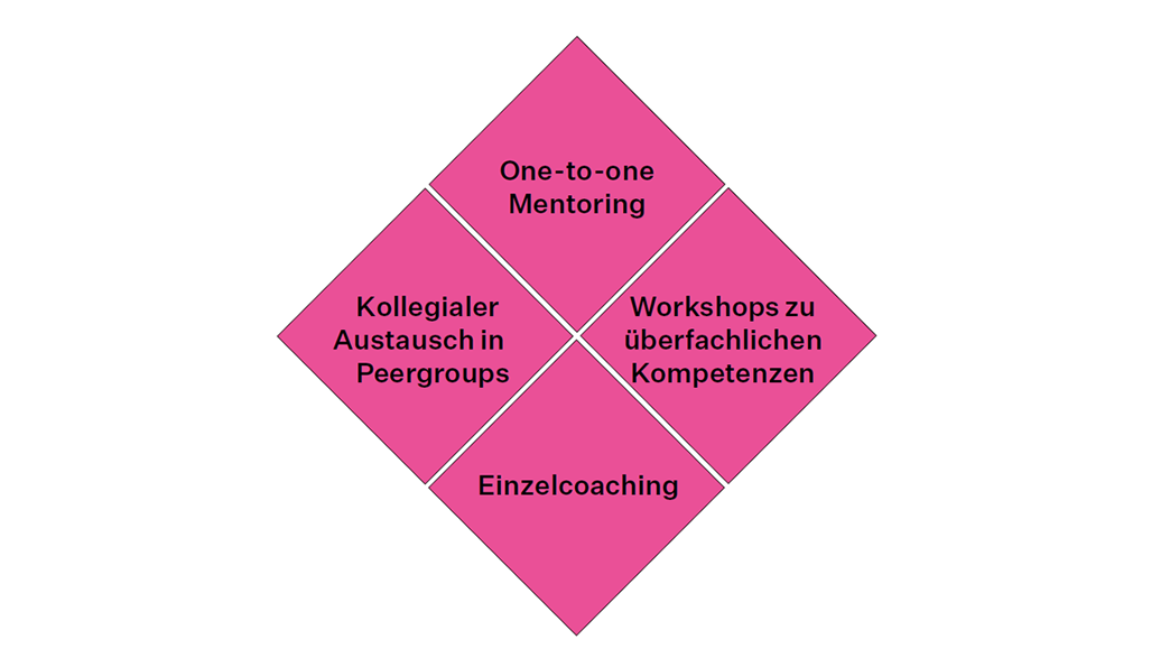
The meant4science framework programme is structured as follows: each mentoring cohort begins with a kick-off event and concludes with a closing event. Furthermore, regular informal discussions with female leaders, experts and entrepreneurs from various sectors and disciplines complement the four core elements of the meant4science mentoring programme.
The four elements of meant4science:
1) One-to-one mentoring: The mentee and mentor form a one-to-one mentoring relationship. The focus is on regular, face-to-face exchanges. It is recommended that at least three meetings, prepared and organised by the mentees, take place during the programme year.
2) Peer-to-peer exchange in peer groups: As mentees, you will meet regularly in groups that may change from time to time. During these meetings, you will offer each other advice and support on matters relating to mentoring, your career or your further academic development.
3) Workshops on soft skills: During the programme year, all mentees take part together in workshops on personal development and soft skills, led by qualified trainers.
4) One-to-one coaching: You will have the opportunity to discuss your personal concerns during a one-to-one coaching session. Possible topics may include your career planning, dealing with specific challenges, or other matters relating to your career and/or personal development.
(Please note that the chart is only available in German.)
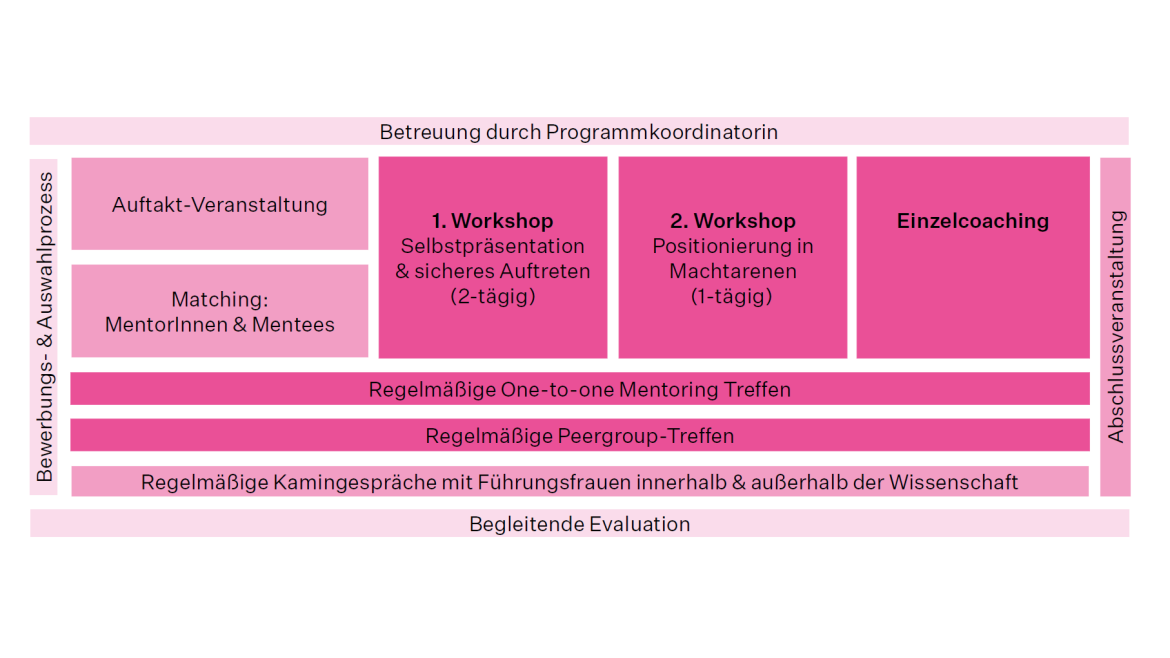
(Please not that the chart is only available in German.)

meant4science brochure
You can also find all the information about the meant4science mentoring programme in the following brochure.
meant4science brochureSupport for individuals with greater support needs
Find out more about funding for individuals with greater support needs .
For young parents and single parents, amongst others, there is, for example, the option of receiving help from a Student Assistant.
Funding bodies
The meant4science mentoring programme is a sub-project of attract2HM (grant reference: 03FHP130A), which is funded by, amongst others, the BMFTR.