Strategic objectives in the University Development Plan (HEP) 2023
Find out more about Hochschule München’s strategy here
The revised version of the HEP, adopted on 8 February 2023, provides a solid foundation for the innovative further development of HM.
It provides scope to think about HM in new and different ways, whilst at the same time drawing practical conclusions in the form of specific packages of measures.
Furthermore, the HEP serves as a platform for a university-wide discussion process, during which the areas of teaching, research and knowledge transfer have been integrated both with the cross-cutting themes (digitalisation, internationalisation, sustainability, equality and entrepreneurship) and with the department development plans (FEP).
Area of Action: Transfers
In the Bayerischen Hochschulinnovationsgesetz BayHIG (Bavarian Higher Education Innovation Act) enshrines knowledge transfer as a core function of higher education institutions (see, in particular, Article 2(2), third sentence, of the BayHIG). Higher education institutions are increasingly being recognised as playing a key role in safeguarding Bavaria’s capacity for innovation and its long-term viability.
HM’s vision is to strategically expand the knowledge transfer network in the Munich metropolitan region, thereby actively influencing the region’s innovative capacity and drawing on impetus from the network. In particular, the aim is to strengthen the already successfully established knowledge transfer focus on entrepreneurship, with its associated start-up and innovation culture (HM and the Strascheg Center for Entrepreneurship rank first in the Gründungsradar 2022, the largest comparison of start-up support at German universities).
Knowledge transfer is regarded as a core task at HM, and as such it is committed to its mission of making an impact on the economy and society as a state-funded university of applied sciences. Together with teaching and research, the HM’s knowledge transfer activities address pressing societal challenges.
Collaborations should be structured on the basis of a broad understanding of knowledge transfer: socially responsible, science-led, interdisciplinary, participatory, respectful, based on trust and designed for the long term.
Strategic Objectives: Transfers

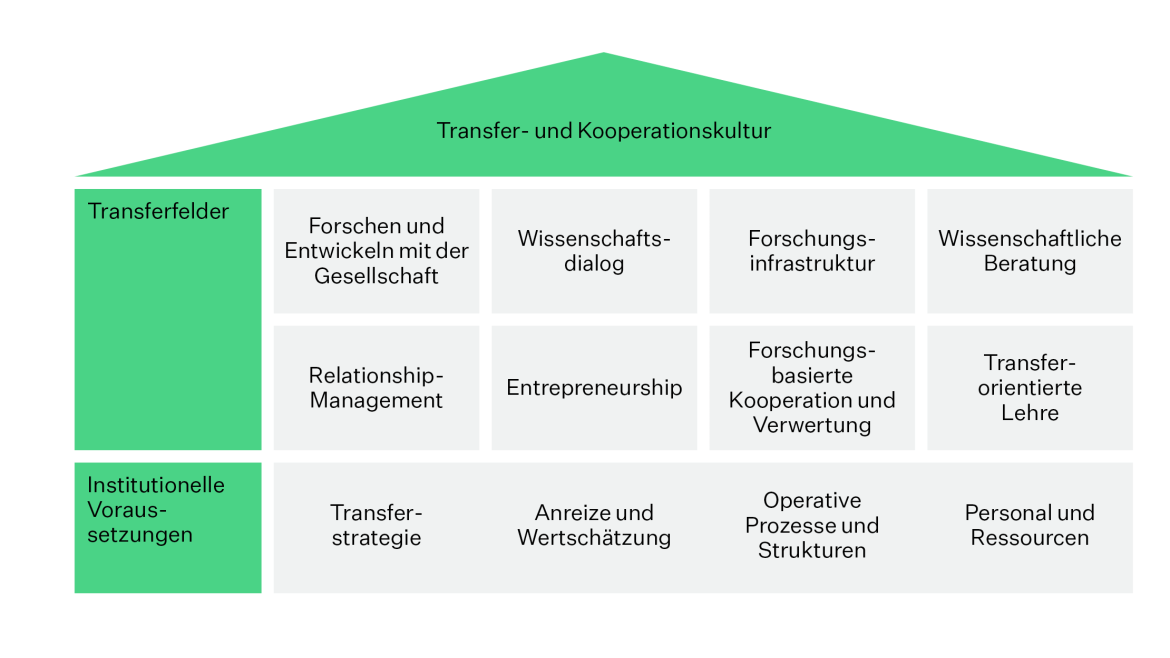
In its HEP, Hochschule München has set itself the following strategic objectives for the ‘Knowledge Transfer’ area of focus:
- Strengthening transfers and research in partnership with society
- Developing and illustrating transfer strengths
- Expanding relationships that foster knowledge transfer
- Establishing the institutional framework for transfers