
Does meditation give you superpowers?
Meditation has a positive effect on the part of the brain responsible, among other things, for regulating attention and decision-making. Meditation can reduce stress, boost concentration and improve self-awareness – a real superpower that you can use anytime, anywhere.
Professor Andreas de Bruin from the Department of Applied Social Sciences at HM is conducting research into this topic.
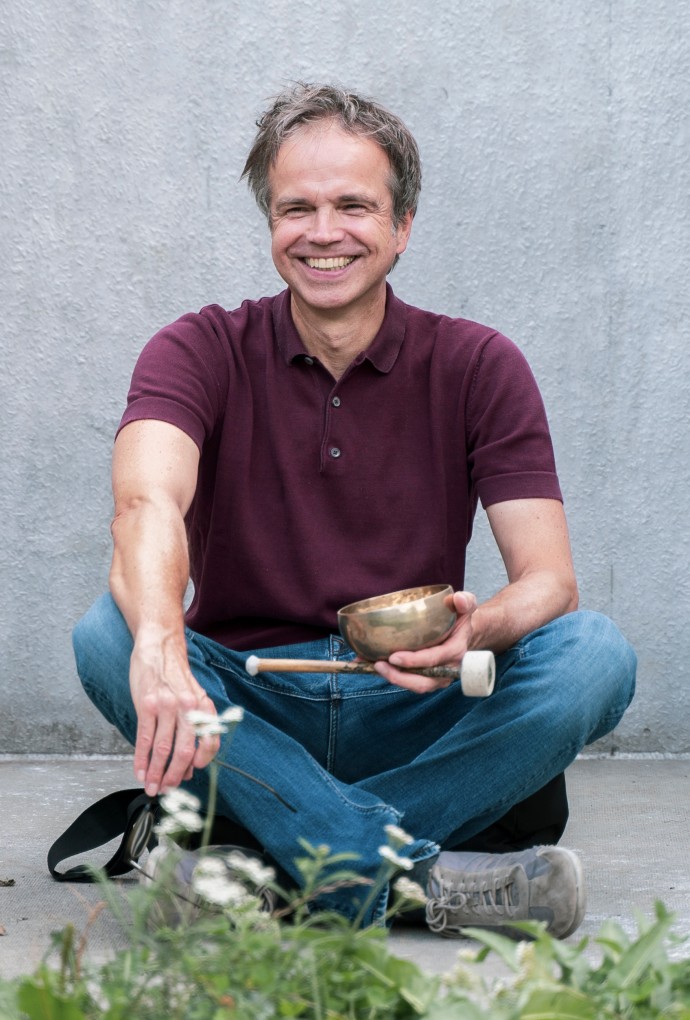
Why did you start meditating, and why do you still do it?
I have been meditating myself since 1991, and for me, meditation has always been an inner compass. It has helped me gain greater insight into the workings of my thoughts, feelings and physical sensations. It has enabled me to be more attuned to my inner self. When I have a stronger connection with this inner voice, I have a clearer sense of what I am meant to do here in my life.
How did you come up with the idea of teaching mindfulness and meditation at the university and launching the Munich Model?
Above all, it was important to me that students were given the opportunity to get to know themselves better. This enables them to discover what contribution they would like to make to society. Furthermore, I was naturally also interested in the neuroscientific evidence underpinning the effectiveness of mindfulness and meditation. There is now a wealth of positive evidence for these benefits, such as improved mental well-being. Other benefits include enhanced body awareness, concentration and selective perception, as well as increased self-efficacy, well-being and the ability to regulate one’s own emotions. In 2010, I began introducing mindfulness and meditation at the university and embedding them in the curriculum. At the time, this was something completely new.
Are mindfulness and meditation beneficial for a healthy mind?
From a neuroscientific perspective, it is believed that people could be happier if they gained more control over their minds. Four components are key to a healthy mind: firstly, the fundamental recognition of awareness; secondly, connection – that is, possessing emotions such as compassion, kindness and gratitude, and thereby engaging with one’s environment; thirdly, insight into one’s own self; and fourthly, recognising one’s own purpose in life and aligning one’s behaviour with it. Mindfulness and meditation practices can make a significant contribution here.
Can anyone meditate?
Alongside the numerous positive effects of meditation, there are also some risks. Although experience suggests that these do not occur all that frequently in a university setting, it is nevertheless sensible and responsible to address these issues systematically. In my book, I have described several risks. Provided these risks are taken into account, I see no reason why one should not begin practising meditation techniques. It would be a pity if students who show a genuine interest in this were to be denied this opportunity.
If I want to try meditation, how do I get started?
My suggestion would be to learn a seated meditation technique and practise it regularly. Everyone has their own unique potential, and meditation can help to unlock it. There are various approaches to this, but the main focus is on learning to focus on an object of meditation. This could be, for example, the breath, a mantra, an image, the point between the eyebrows or a sound. This training of concentration calms the mind and helps you connect more deeply with yourself. It is important to carry out the exercises with a sense of calm. In my book, I present various approaches to meditation.
The book by HM Professor Andreas de Bruin can be downloaded free of charge in German and English.
In addition, a journal on the Munich Model, *Mindfulness and Meditation in the Higher Education Context*, has also been published in German and English.
Still not full?
Ask the Mindsnacks team or keep browsing our Mindsnacks website.