News
Handbook: Co-creation in Urban Development
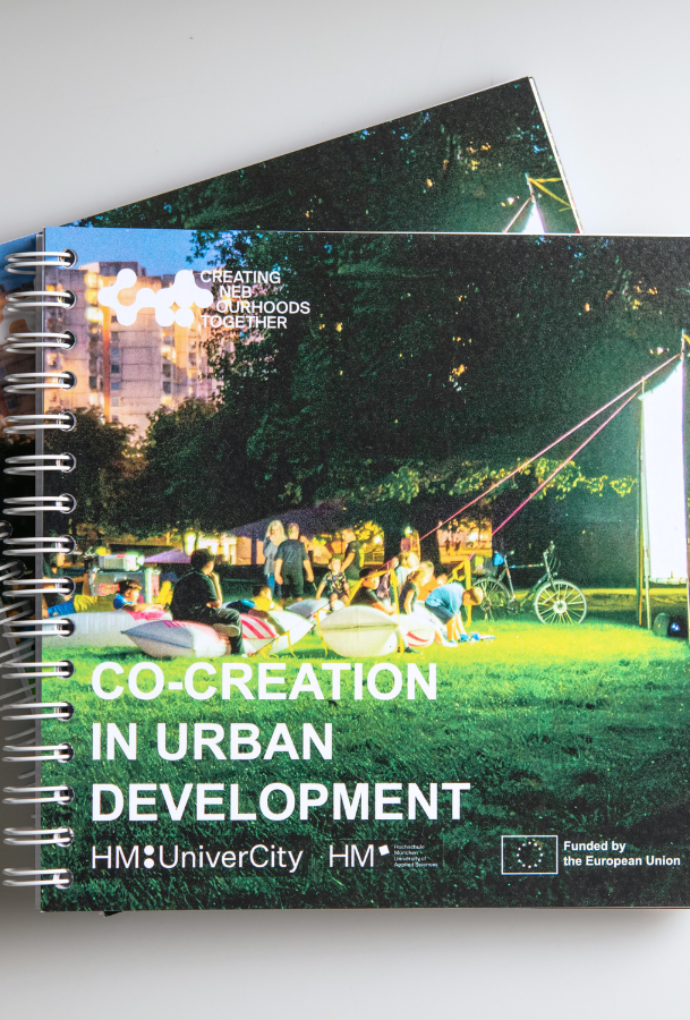
We are delighted to share our handbook: Co-Creation in Urban Development, produced as part of the NEBourhoods – New European Bauhaus flagship project!
27/04/2025
How can we work together to shape sustainable urban futures – across sectors and in partnership with local communities?
It contains key findings from over two years of applied co-creation in Munich-Neuperlach, one of Europe’s largest post-war residential areas.
Produced as part of the inspiring New European Bauhaus initiative, this handbook reflects the values of ‘Beautiful’, ‘Sustainable’ and ‘Together’. It describes creative methods, practical tools and valuable learning experiences from collaborative urban development – with a focus on practically-oriented testing through living labs, collaboration with stakeholders and iterative prototyping.
What can you expect to find in the handbook?
Understand why co-creation is essential in urban development – particularly in today’s complex landscape
Learn how to successfully manage iterative processes in complex, multi-layered environments
From idea to implementation: how to identify relevant stakeholders, involve them effectively and set up living labs for testing
Reconciling local ideas and resources with the necessary structural transformations
Translating scientific findings and ideas into inspiring real-world laboratories
Click here for the handbook
. Please do get in touch if you’re working on similar processes in your town or organisation, or if you have any questions! There are also printed copies available – please leave a comment or get in touch if you’d like one.
Michael Droß
Peter Brooren
Jana Köstler
Nicola Sennewald
Natalia Chikanchi
Hochschule München
Published by HM:UniverCity
A big thank you also to our project coordinator, Sylvia Pintarits, from the City of Munich, and to all our other project partners!
“Creating NEBourhoods Together” is funded by the European Union. However, the views and opinions expressed are solely those of the authors and do not necessarily reflect those of the European Union. Neither the European Union nor the funding authority can be held responsible for them.