News
“Research must be made accessible to the public”
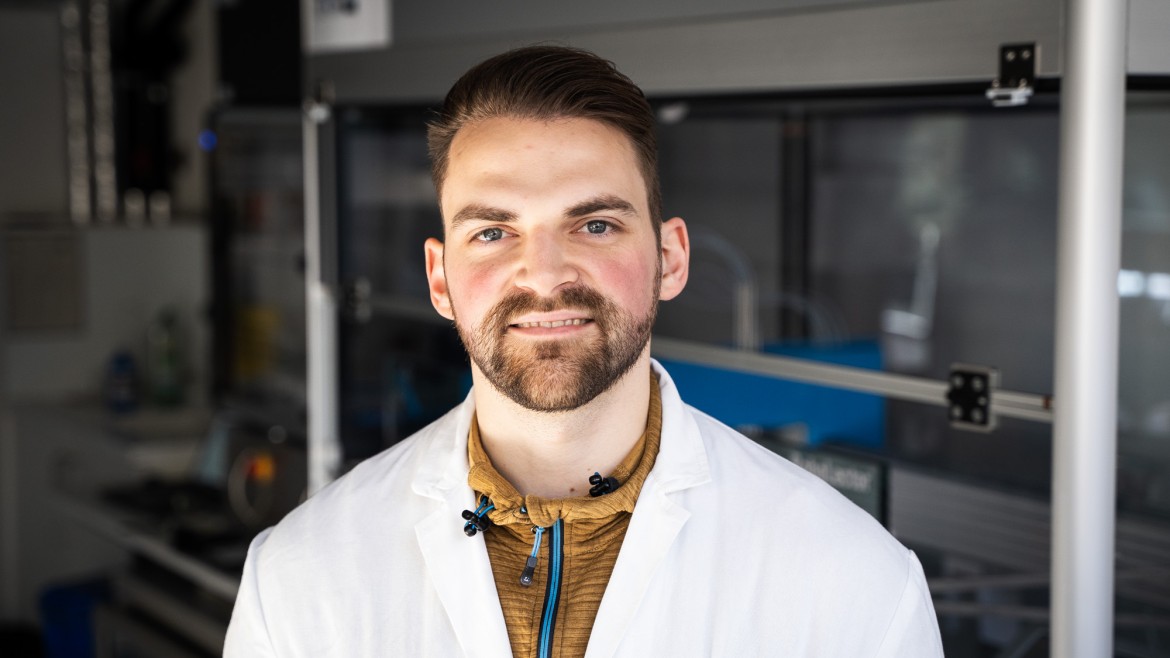
Why science belongs on stage and why science slams are more than just entertainment: an interview with Patrick Hanisch
08/07/2026
Whether on stage or in the laboratory, Patrick Hanisch knows how to communicate science in a way that is easy to understand. A research staff member at the Department of Engineering and Management, he is investigating how bacteria can break down hard-to-degrade azo dyes from industrial wastewater.
Since his first appearance at the HM’s Applied Science Slam in the winter semester of 2023/24, he has already presented his research at around 20 science slams in Germany and Austria – and will soon be doing so in Switzerland as well. In this interview, he talks about how complex research can be turned into a fascinating story and why science should not only reach people but also inspire them.
HM: Mr Hanisch, you are researching how bacteria can break down azo dyes. What exactly does this involve – and why is this topic socially relevant?
Patrick Hanisch: We are investigating how bacteria can break down certain industrial dyes, such as those used in textile production, which end up in wastewater. These so-called azo dyes are very difficult to break down. We’re interested in which bacteria are capable of doing this and how the process works, so that it can be specifically utilised for industrial wastewater treatment. This is particularly important because it’s about cleaner water, protecting our water resources and also the circular economy – in other words, using water more sustainably and ensuring fewer pollutants enter the environment.
How do you manage to present such a complex research topic in a way that even people without a scientific background enjoy listening to?
Patrick Hanisch: Essentially, it’s about telling a story: What is the problem? Why is it relevant? And what solution is research trying to find? You first have to show people how your own research affects and can influence their lives. With azo dyes, this is fairly straightforward because we come across them all the time in our daily lives – for example, in textiles or food – without even realising it. Potential risks can also be explained using concrete examples, such as the fact that some breakdown products of azo dyes are suspected of being carcinogenic. Only then do I explain what I actually do in the laboratory and how I go about it. Naturally, it’s all kept at a simple level, but that’s perfectly sufficient.
Science slams combine entertainment with research. Why do science and society need such formats?
Patrick Hanisch: Many areas of research are highly relevant to society. The only problem is that most people aren’t even aware that they exist. Science slams are therefore an excellent form of science communication for showing what we, as researchers, are actually working on in our laboratories and at universities. Research must be made accessible to the public. Very few people sit down and read scientific publications – not even when they’re actually interested in the topic.

What do you personally find most inspiring about presenting your research not only in the laboratory but also on stage?
Patrick Hanisch: I particularly enjoy the audience’s reactions. It’s great to see when people suddenly have an ‘aha’ moment and realise that research can be both exciting and accessible. I’m just as delighted when they laugh at certain points, discuss them or ask questions after the talk.
The interview was conducted by Lisa Miethke