News
Talking saves lives
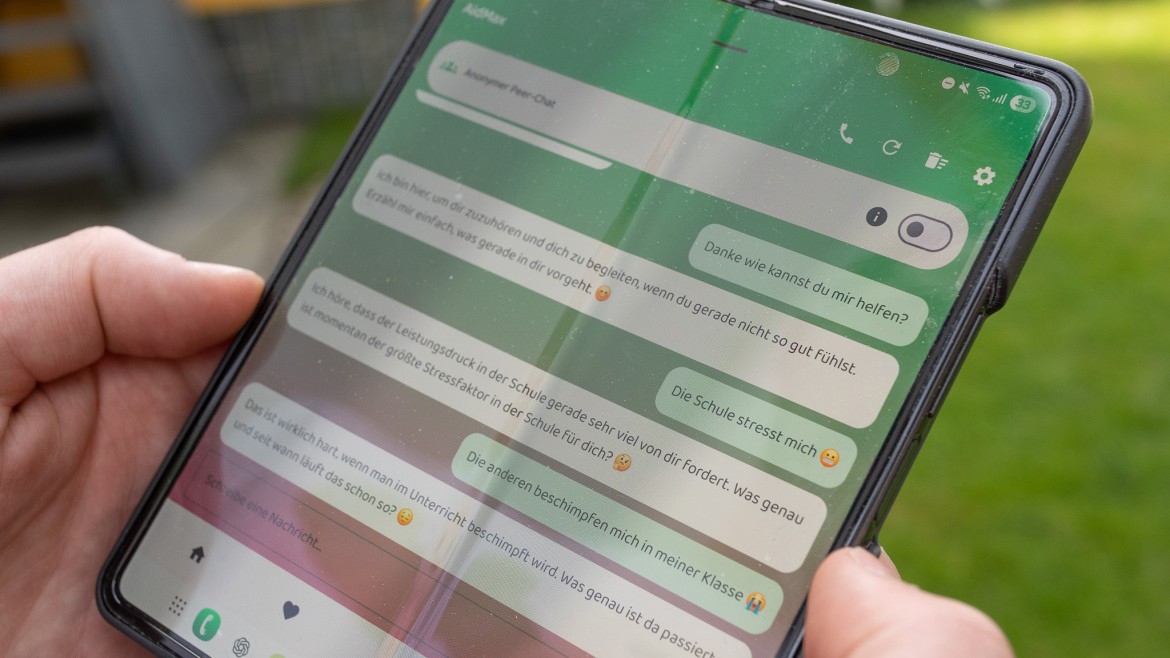
The AI chatbot AidMax listens when no one is there
15/07/2026
Around 5 to 12 per cent of young people in Germany suffer from depression, which is often not recognised until it is too late. They are often reluctant to confide in anyone – out of insecurity, shame or because there is a lack of support services. This is exactly where AidMax comes in: an AI-powered chatbot designed to offer initial support during mental health crises anonymously, with low barriers to access and around the clock. The system was developed by HM doctoral candidate Korbinian Zacherl. His idea was sparked by the suicide of a young person in his circle who had already been receiving therapeutic help.
First aid via chat
Following this tragedy, one question in particular arose for Zacherl: how can support be available at all times, even outside therapy sessions or during acute periods of distress? He developed the answer to this question in the form of AidMax as part of his Master’s thesis in Business Informatics at the Department of Computer Science and Mathematics. “I wanted to create a platform that combines artificial intelligence and empathy and listens when no one else is there,” says Zacherl, describing his motivation. AidMax can be used via popular messaging services such as WhatsApp or Telegram. Young people can share their thoughts there without registering and receive an immediate response. During development, Zacherl worked closely with psychologists, incorporating practical insights from crisis counselling.
In an emergency – for example, in the event of suicidal thoughts – the system alerts a network of trained volunteers and therapeutic professionals.
Someone from the team then takes over the chat with the person concerned and provides mental first aid. The user decides for themselves whether they wish to remain anonymous.
AI-powered speech analysis for personalised support
Since completing his Master’s thesis, Zacherl has been continuously developing his non-profit start-up. AidMax is now part of the IHelp-Project e. V. association, which was founded by the father of the young person who passed away, together with his daughter. Tests involving around 50 people, as well as trials in a school setting, have yielded a great deal of positive feedback. The young people found it helpful to have someone to write to at any time and to feel less alone with their problems. The team is currently working on its own app, which is set to offer additional features, such as daily check-ins, guided exercises and personalised support. There are also plans to integrate and analyse voice messages. To this end, Zacherl intends to develop an AI voice analysis system as part of his doctorate at the Doctoral Research Center for Applied Computer Science at HM, in cooperation with OTH Regensburg. This system is designed to recognise from the user’s voice whether they sound, for example, sad or tense, and to respond accordingly.
Ethical standards and scientific evaluation
The PhD thesis places particular emphasis on the ethical design of AI. Each new feature is scientifically monitored and evaluated under the supervision of HM Professor Markus Endres, and coordinated with experts in ethics, psychology and data protection. Around 30 volunteers are now involved with AidMax. The team also receives support from the Incubation Programme at the Strascheg Center for Entrepreneurship (SCE).
The long-term aim is for AidMax to be deployed across Europe. Zacherl’s vision: “No one should ever have to feel alone again when facing a mental health crisis.”
Heidi Bundschus