News
INSIDE: PhD
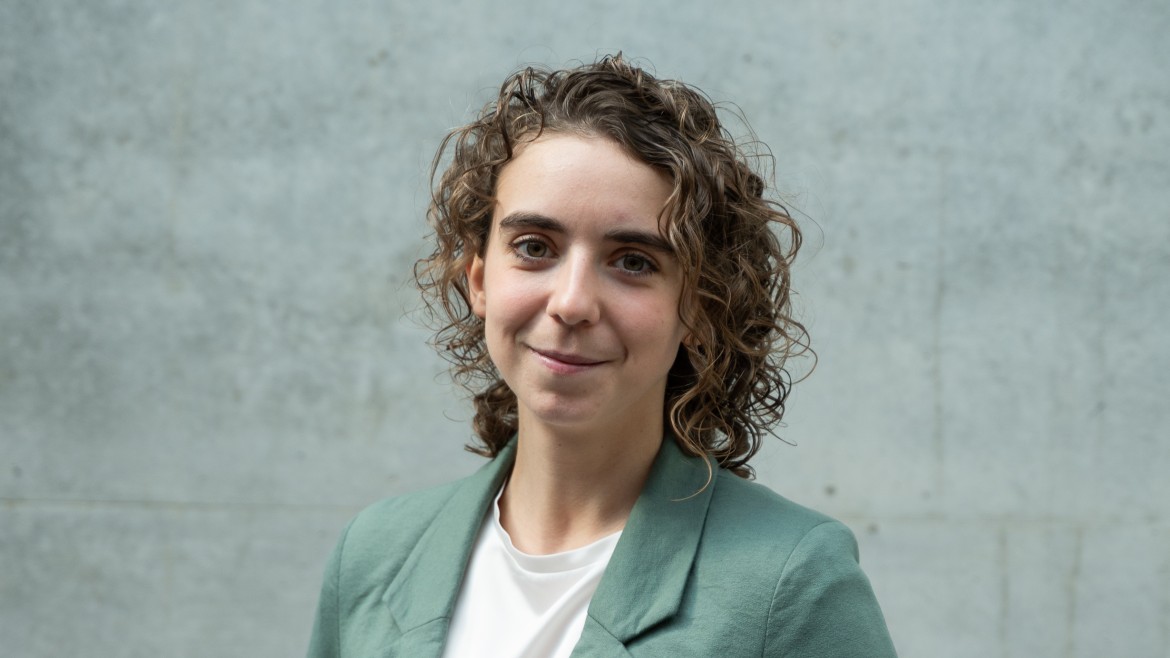
HM doctoral candidate Lea Wendler is conducting research into more robust steel structures
27/09/2026
How do steel structures last for ages? This is the question HM doctoral candidate Lea Wendler is exploring. In her PhD thesis at the HM Doctoral Research Center of Integrated Buildings (PZIB), she is investigating what is known as ‘high-frequency hammering’ – a specialised process that makes welded joints in steel structures more robust.
What is your research into?
My research focuses on the fatigue behaviour of welded joints in steel structures. These are often the weak point in steel structures. One solution is a technique known as high-frequency hammering: this involves the targeted mechanical deformation of the weld at the critical point in order to improve its load-bearing capacity.
In my work, I am investigating this process to clarify outstanding issues.
What fascinates you most about your field of research?
I like the mix of experimental and theoretical work: carrying out the experiments using a range of measurement techniques, but also the subsequent evaluation and analysis of the results using various computational models.
What do you hope to achieve with your research?
I hope to use my research to resolve outstanding issues and thereby contribute to wider practical application of the process. By extending the service life of welded structures, the process can also make a long-term contribution to sustainability.
Why did you decide to pursue a career in academia?
I’d already had the opportunity to get to grips with the subject and academic work whilst writing my Master’s thesis. As I found both fascinating, I was happy to take the chance to stay in academia and continue exploring this field of research.
What do you do in your spare time when you’re not doing research?
Lots of sport! Mainly running and road cycling.
The interview was conducted by Constance Schölch