
Can democracy be fixed?
The RePair Democracy project has developed the ‘Democracy Café’, a format in which residents can raise and discuss their concerns regarding quality of life in the neighbourhood. This enables them either to put specific ideas into practice directly or to bring them to the attention of local politicians – a social innovation that fosters participation and ‘repairs’ democracy.
Research on this topic was carried out by HM Professor Gerald Beck from the Department of Applied Social Sciences and Dr. Robert Jende, who now works at the anstiftung.
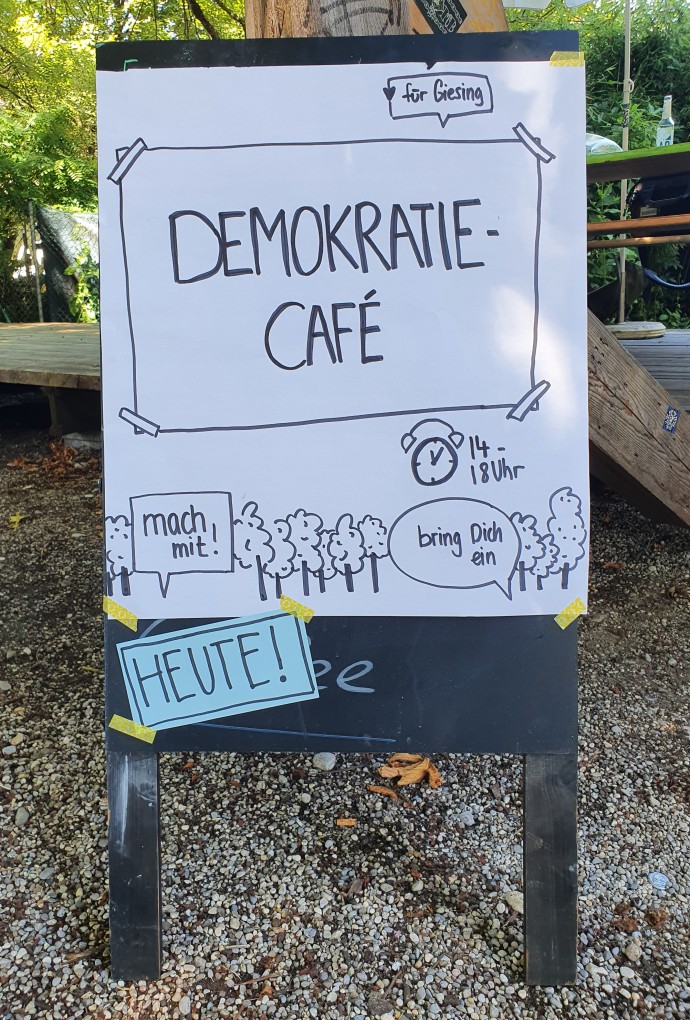
What is the concept behind the Democracy Cafés? What exactly do they involve?
Beck: The idea behind Democracy Cafés is modelled on the concept of Repair Cafés, only with a focus on democracy. Instead of taking a broken appliance to a Repair Café and fixing it with the help of a suitable repairer and shared tools, people bring their neighbourhood concerns to the Democracy Café and work together to find a way to address them. In doing so, we create a hub for jointly shaping our immediate living environment and participating in democracy in ways other than just through elections.
What specific issues do participants raise at the Democracy Cafés?
Jende: Mobility is often a key issue; usually, there is too much space for cars and not enough green space in the neighbourhood. However, participants also show a keen interest in intergenerational coexistence and how this can be shaped and put into practice. Furthermore, democracy itself is frequently a concern, in the sense of active involvement in what happens in their own neighbourhood.
How does the concept of Democracy Cafés help to shape democracy in a more ‘bottom-up’ way?
Jende: Through ‘home-grown’ democracy in the neighbourhood, co-creation among residents becomes the very heart of democracy. The Democracy Cafés provide a platform where people can work together to shape their immediate living environment. In this way, they help to revitalise democracy at a local level. It is important that everyone is heard there, regardless of their background, wealth, religious affiliation, age or voting rights.
What does the future hold for the Democracy Cafés? What are your goals?
Beck: The project actually came to an end back in December 2022, but its practical implementation – which we at HM continue to support – is only now really gaining momentum. We provide information material and guidance via the network’s website: www.demokratiecafe.de. This includes a toolkit for interested organisers – a sort of written practical guide. Through a Germany-wide network, the structures are to be further developed and the individual Democracy Cafés will learn from and with one another.
Still not full?
Ask the Mindsnacks team or keep browsing our Mindsnacks website.