
Which vegetables can you write on?
Made from asparagus. Discarded asparagus, peelings or scraps are blended with water and turned into paper without the use of any chemicals. The asparagus fibres are used to make sheets of paper or sustainable packaging, such as strawberry punnets or egg cartons.
Professor Helga Zollner-Croll from the Department of Technical Systems, Processes and Communication at Hochschule München is conducting research into this topic.
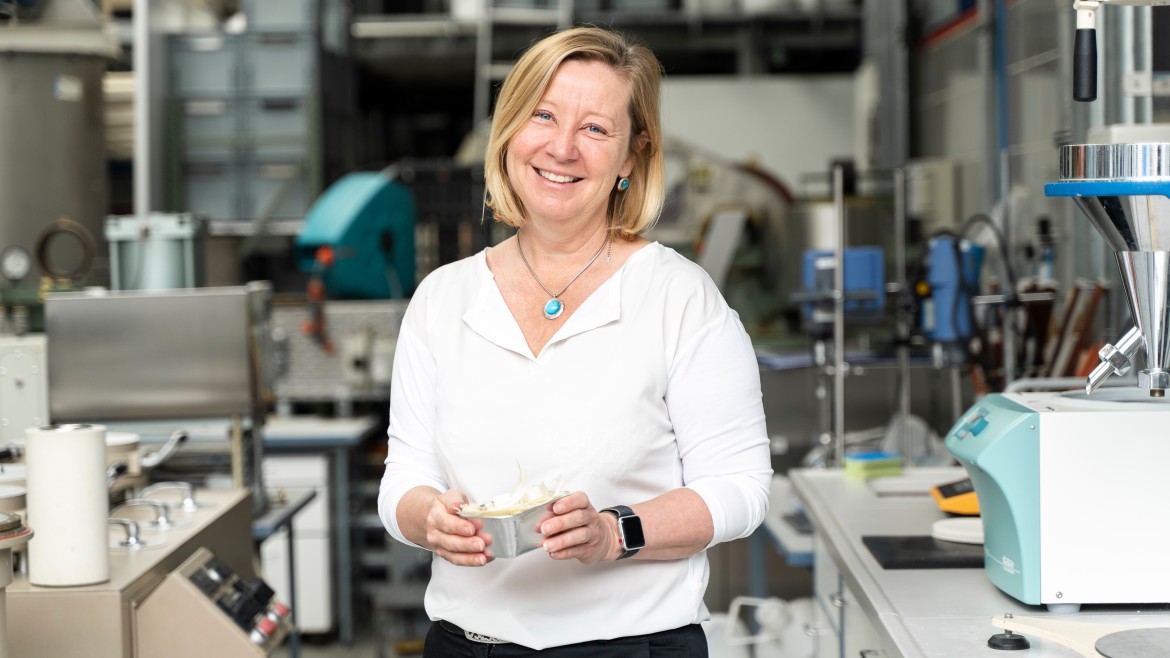
At least a third of the annual asparagus harvest in Germany ends up in the bin. Crooked or rejected asparagus, peelings or trimmed ends are simply thrown away and therefore go to waste. As a countermeasure, HM Professor Helga Zollner-Croll led a research project at the Department of Technical Systems, Processes and Communication. The aim? To use previously wasted asparagus as a raw material for cardboard or paper production.
Splitting asparagus fibres
The project began by investigating the extent to which asparagus waste is suitable for use in the production of fibres for packaging materials. To this end, the research team pulped the asparagus using a pulp mill. This breaks down the asparagus fibres so that their various properties can be examined in the laboratory.
The test phase revealed that asparagus fibres are suitable for paper production. However, the fibre yield is low due to the very high water content. As the asparagus foams when chopped up with water, it is also very important to wash it before grinding. This reduces the impact on the water cycle and increases the tensile strength of the fibres. The choice of asparagus variety is also important, as this has a major influence on the grinding result.
Manufacturing packaging trays
After mixing, the water slowly drains off through a cylindrical vessel – leaving behind the fibrous material. The mixture is poured into a mould and dries to form a tray. “Using a laboratory fibre casting process, we were able to produce packaging trays. The rough surface is particularly well suited for strawberry punnets or egg cartons,” says Zollner-Croll of the results of her laboratory tests. The individual asparagus fibres are clearly visible in the paper, and the light beige colour reflects the naturalness of the paper.
The vision for the future is to make the best possible use of the asparagus fibres until their full potential has been realised in the interests of sustainability. For example, an asparagus farm could use the fibres to make small baskets for selling its own strawberries on the farm – an ideal process in terms of the circular economy.
Still not full?
Ask the Mindsnacks team or keep browsing our Mindsnacks website.