Systems Entrepreneurship & Transformation (M. Sc.)
Understanding complexity. Shaping change.

Short Overview
Degree: Master of Science (M.Sc.) in Systems Entrepreneurship & Transformation
Duration: 24 months (4 semesters), Start: March 2027
Credits: 90 ECTS
Language of instruction: English
Study mode: Part-time, mostly online complemented by on-site sessions
Start: Every summer term (March)
Costs: 21,000 EUR (5,250 EUR per semester) subject to approval by the committees of Munich University of Applied Sciences
Application period: November 15 - January 15 (via PRIMUSS )

WHY SET?
Societal, environmental, and technological developments are bringing about fundamental changes to the economy, politics, and civil society. Global crises, new technologies, geopolitical tensions, and the increasing demand for sustainable and responsible business practices are elevating the pressure for change on organizations across all sectors. At the same time, there is a growing need for professionals and managers who are able to understand complex correlations, analyze systemic interactions, and actively shape transformational processes. Various studies and international reports have shown for years that the ability to deal with complexity and develop sustainable future prospects is one of the key professional skills of the coming decades.
WHAT TO EXPECT
The part-time master’s program Systems Entrepreneurship & Transformation at Munich University of Applied Sciences prepares you to understand complex societal, economic, and technological interrelationships and to actively shape change. You will learn to understand systems holistically, support transformation processes, and implement innovation responsibly. The program focuses on systemic thinking, interdisciplinary collaboration, the involvement of various stakeholders, and methods for shaping the future and driving innovation. Through the close collaboration with our partner universities in The Hague, Sarajevo, and Rome, you will also gain a European perspective and learn how to face transformational challenges in an international context.
WHAT’S AFTER?
The curriculum combines systems analysis, future-oriented skills, transformation design, innovation methods, and responsible leadership. It equips you to understand complex developments, devise strategies for the future, and implement innovative solutions. You will be able to actively shape transformation, analyze interconnections and interactions from a systems perspective, and help shape economic and social developments in a sustainable way. After graduation, various professional opportunities will open up for you – for example as transformation manager, strategy consultant, corporate sustainability lead, intrapreneur driving new ventures within established firms, or policy advisor on innovation and digital transformation for government agencies.

What makes this program unique?
- Interdisciplinary approach: By combining technology, social sciences, and futurology, the program equips students from diverse disciplines to take on transformational leadership roles.
- International scope: On-site field trips to the partner universities in Munich, The Hague, Sarajevo, and Rome, and an international cohort foster a shift in perspective.
- Emphasis on practice: Company visits, insights into innovation ecosystems, and a group of students with professional experience ensure a practical focus.
- Systemic focus: The master's program understands transformation processes as interconnected challenges within dynamic contexts. It teaches methods to assess complex interactions and to derive development strategies.
- Duration: 4 semesters, part-time
- Start: Annually in the summer semester
- Degree: Master of Science (M.Sc.)
- ECTS: 90
- Language: English
- Application: Centralized through the Munich University of Applied Sciences
- Application period: 15 November to 15 January
- Enrollment at the Faculty of Engineering and Management (FK 09)
- Cost: 21,000 EUR (5,250 EUR per semester) subject to approval by the committees of Munich University of Applied Sciences + travel & accommodation costs for field trips
- Participants: Maximum of 30 per cohort
Questions? Contact Program Manager Verena Suhm via email: verena.suhm@hm.edu
Application process:
Submit your documents between November 15 and January 15 every year for the summer term in PRIMUSS
- Proof of a first university degree worth 180-210 ECTS and at least six semesters of theoretical study. If your degree comprises 210 ECTS, no further proof is required. If your degree comprises 180 ECTS, you must provide evidence of an additional 30 ECTS-equivalent (e.g., via relevant courses, work experience, or an internship) gained over one year, in accordance with our Study Regulations (Studien- und Prüfungsordnung).
- Note: Applicants who did not complete their previous degree in Germany must submit a VPD (Vorprüfungsdokumentation). Please consider the processing time of up to 8 weeks for the VPD process.
- Bachelor's degree with an overall grade of “good” or better, or an equivalent degree
- Proof of English proficiency at B2 level of the Common European Framework of Reference for Languages
- Proof of at least 1 year of full-time working experience after you finished your first degree
- CV
2. A successful 30-minute application interview (usually by end of January)
3. Acceptance or rejection in the program (usually mid-February)
- Format:
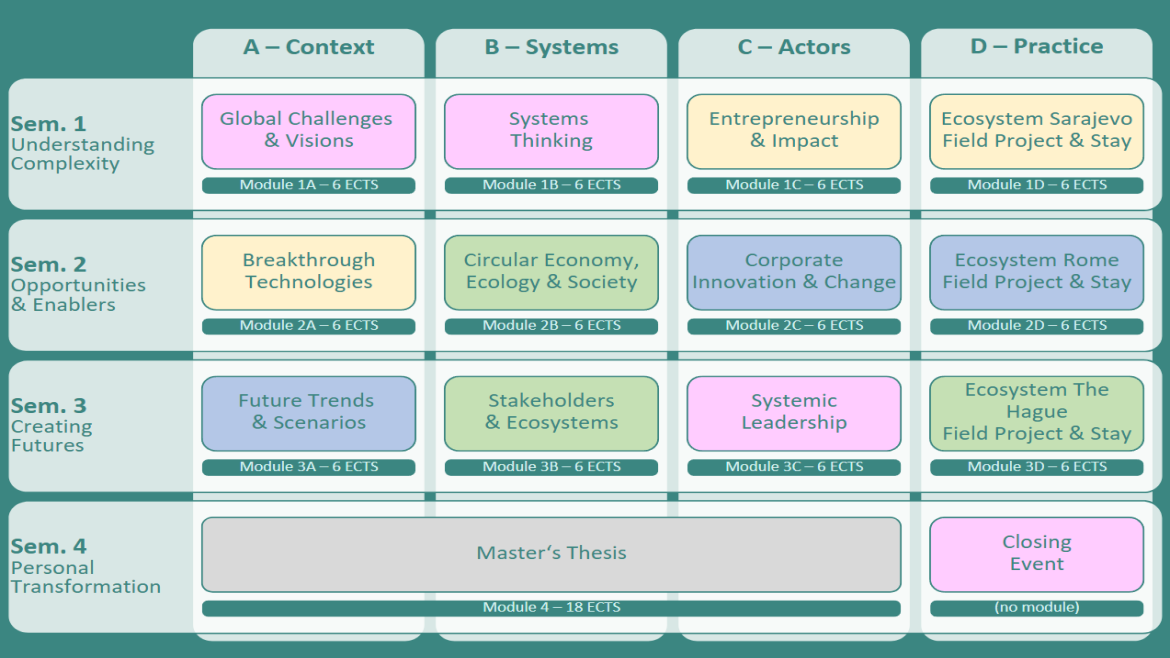
Curriculum Focus:
- Understanding Systems: Systems thinking, circular economy, analysis of ecological, economic, and societal correlations
- Implementing Innovation: Shaping transformational processes in organizations and society, corporate innovation and intrapreneurship, entrepreneurship and societal impact
- Thinking Globally: Global challenges, visions, and experiences in various European ecosystems
- Leading Responsibly: Systemic leadership, strengthen your own leadership role, apply systemic approaches
- Shaping the Future: Futures studies, trends and scenarios, groundbreaking technologies, deriving strategic courses of action
- Open to professionals from all backgrounds
- Work experience: At least 1 year full-time after first degree
- Good English skills are required (at least level B2 of the Common European Framework of Reference for Languages)
- Proof of completion of a degree program at a German university comprising at least 180 ECTS credits and at least six semesters of theoretical study, with an overall grade of “good” or better, or an equivalent degree
Two-stage application process
- Timely and complete application via the application portal of the Munich University of Applied Sciences
- 30-minute interview with professors of the master’s program
Who benefits most?
- Responsible leaders: Those in or on their way to leadership roles who take on social responsibility and initiate change
- Startup-oriented innovators: Developing new ideas and innovative business models with societal value
- Committed advocates for the common good: Employees from public institutions, NGOs, companies, or social organizations driving sustainable solutions
Program of
Initiated by
Funded by