The Junior Professorship at the HM
Would you like to become a Professor at HM, but do not yet meet all the requirements for appointment because you have not yet completed your doctorate or do not yet have the necessary professional experience? If so, the early-career professorship is the ideal next step in your career!
Career path: Junior professorship on a tenure-track
As a junior professor (W1), you will gain your first experience as a professor at the university of applied sciences, contribute your expertise in teaching, research and transfers, and at the same time fulfil any remaining appointment requirements for a full professorship at the university of applied sciences.
At HM, every junior professorship is a tenure-track position. This means that, following a positive evaluation, the holder is appointed to a permanent full professorship (W2). HM thus offers up-and-coming talent a predictable career path and long-term professional prospects.
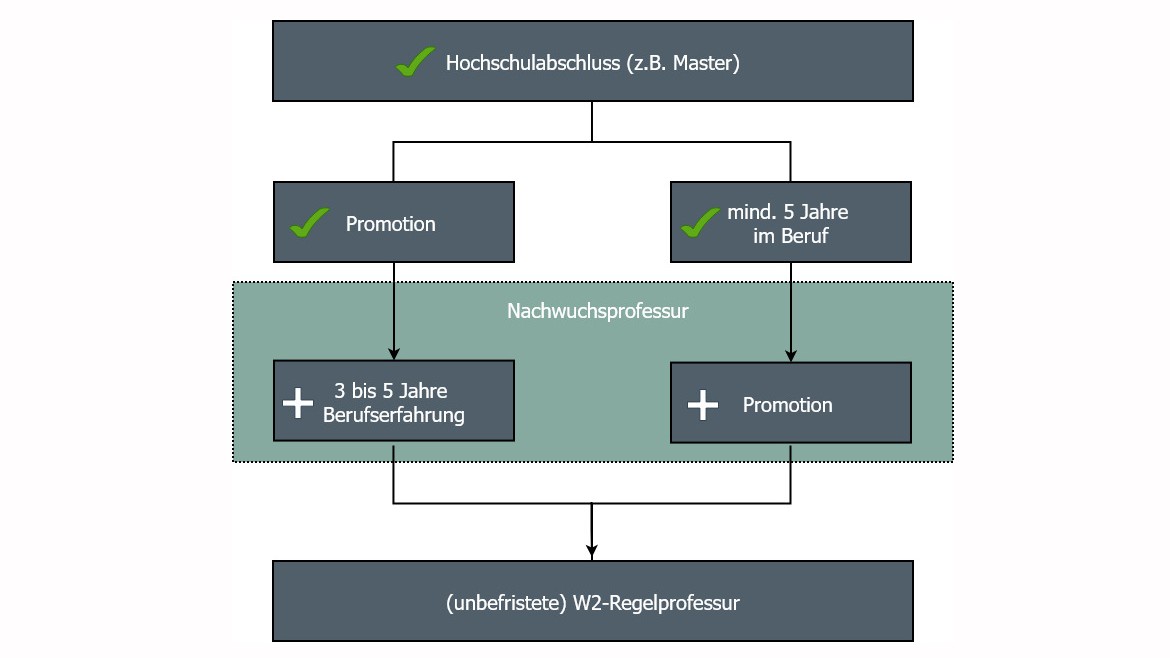
With the doctorate track and the professional track, there are two different qualification pathways to choose from (please note that the chart is only availaible in German):
Practice Track or Doctorate Track
In the Practice Track, researchers who have completed their doctorates gain the professional experience required by law for a standard UAS professorship through concurrent employment with a practice partner. The Practice Track is aimed at outstanding postdocs from all academic institutions (UAS, universities, non-university research institutions, etc.).
On the Doctorate Track, individuals with an excellent university degree and at least five years’ professional experience acquire the academic qualifications required for a standard professorship at a University of Applied Sciences (UAS) as part of a doctorate programme. The doctorate track is aimed at professionals with work experience.
Procedure for the Junior Professorship

A junior professorship generally lasts between 3 and 6 years. The exact duration of the contract is determined on a case-by-case basis during the appointment interview.
At the start of the junior professorship, the role is divided into two parts: half of the working hours are set aside for academic, research and teaching duties, as well as professional development. The other half of the working hours is spent either completing a doctorate on the doctorate track or gaining professional experience with a practice partner on the practice track. Once the doctorate has been completed or the professional experience acquired, the qualification for the professorship is finalised, where necessary, by meeting further development objectives.
At the earliest three years after taking up the post, it is possible for the junior professorship to be converted into a permanent standard professorship (W2) (known as a ‘tenure-track’ position). To this end, the junior professor’s performance and achievements are assessed. The tenure evaluation is based on requirements and development goals agreed on an individual basis at the start of the junior professorship.
Benefits of a junior professorship at the HM


FAQ
In accordance with Section 57(3) of the Bavarian Higher Education Act (BayHIG) and Section 64 of the Bavarian Higher Education Act (BayHIG), interested candidates for a junior professorship must meet the following requirements:
- 1. A completed university degree
- 2. Suitability for teaching
And one of the following conditions
- 3. In the doctorate track: outstanding achievements in the application or development of scientific knowledge and methods during at least five years’ professional practice, which must have been acquired after completion of higher education and of which at least three years must have been spent outside the higher education sector; Periods spent as a trainee teacher or as a research or artistic staff member may be subject to academic credit transfer for a total of up to two years; in special cases, proof of professional experience gained outside the higher education sector may be provided by demonstrating that, over a period of at least five years, a significant proportion of the professional activity was carried out in cooperation between a higher education institution and a non-academic professional setting.
- 4. In the Practice Track: Demonstrated aptitude for academic work, which is generally evidenced by the quality of a doctorate. No more than four years (or, in the fields of medicine or clinical psychology, no more than seven years) may have elapsed between the date of the doctoral degree certificate and the closing date for applications. This period may be extended by up to two years per child or dependent relative in cases where the applicant is caring for one or more children under the age of 18 or one or more relatives in need of care.
If both requirements (Nos. 3 and 4) are already met at the time of application, the applicant cannot be appointed to a junior professorship.
All junior professorial posts currently available are advertised on our website. Unfortunately, this means that unsolicited applications are not possible. If there are currently no suitable positions advertised, we recommend that you register with our talent pool. You will then be notified automatically as soon as a suitable post becomes available.
In the appointment procedure for junior professorships, particular attention is paid to the candidates’ potential for professional and pedagogical development.
Further information on the application and selection procedure can be found under ‘Questions and Answers on the Appointment Procedure ’.
Each junior professorship is established for a period of at least three and no more than six years. The exact duration is set out in the agreement on objectives and is based on the individual requirements and development goals that must be met in order to progress to a permanent standard professorship (W2).
Before an appointment is made, a memorandum of understanding is concluded between the candidate and Hochschule München. This sets out, in particular, the framework conditions (duration, teaching load, financial support, etc.) of the junior professorship and, where applicable, the tenure criteria for progression to a permanent standard professorship (W2).
The performance agreement may set out additional development objectives (= tenure criteria) which must be met as a prerequisite for progression to a permanent full professorship (W2). The purpose of the tenure criteria is to support the early-career professor’s development towards the target position and to contribute to the development of their individual academic profile. The selection of tenure criteria is based on subject- and post-specific requirements, as well as on the individual prior experience of the persons to be appointed. Any adjustment to the development objectives during the term of the junior professorship requires the consent of the junior professor.
The standard teaching load for junior lecturers is between six and nine hours per week. The exact number of hours is set out in the performance agreement.
Junior lecturers on the doctoral track are required to complete a doctorate. The doctorate can be undertaken either at a Doctoral Research Center at HM, as a cooperative doctorate between HM and a university, or at a university or higher education institution with the right to award doctorates that is not affiliated with HM. You can find further information about undertaking a doctorate at HM on the Graduate School’s website.
It should be noted that, at the time the target agreement is concluded, the individual PhD requirements must be met. As a rule, before a post is offered, the candidate must have been accepted as a doctoral candidate at an institution authorised to award doctorates and must provide evidence of this.
Early-career lecturers on the Practice Track gain the professional experience they still lack through an external practice partner. If the early-career lecturership was not originally advertised with a fixed practice partner, a suitable practice partner must be identified and a signed employment contract submitted by the time the appointment is made at the latest. Hochschule München supports prospective junior lecturers in their search for suitable practice partners.
Early-career professors are actively supported in their professional development through annual progress reviews. In addition, an attractive range of professional development opportunities is available to help them deepen and broaden the skills required for their professorship.
A positive tenure evaluation is required for the transition from a junior professorship (W1) to a permanent full professorship (W2). The tenure evaluation is a second, simplified appointment procedure which assesses whether the requirements and development objectives set out in the target agreement have been met. These include, in particular, the successful completion of a doctorate or the successful acquisition of professional experience, confirmation of teaching aptitude, and the fulfilment of the individually agreed tenure criteria. The procedure is set out in the guidelines for junior professorships. The guidelines are available on request.
Further information and testimonials
Here you will find further information and testimonials about the early-career professorship.
Contact person

Funding bodies
The Junior Professorship at the HM is a sub-project of attract2HM (grant reference: 03FHP130A), which is funded by, amongst others, the BMFTR.