Centre for Physical and Biomedical Engineering (CPaB)
The Doctoral Research Centre for Physical and Biomedical Engineering (CPaB) focuses on applying the latest findings and methods in physics to develop innovative applications in the fields of biomedicine, sensor technology and microsystems engineering.
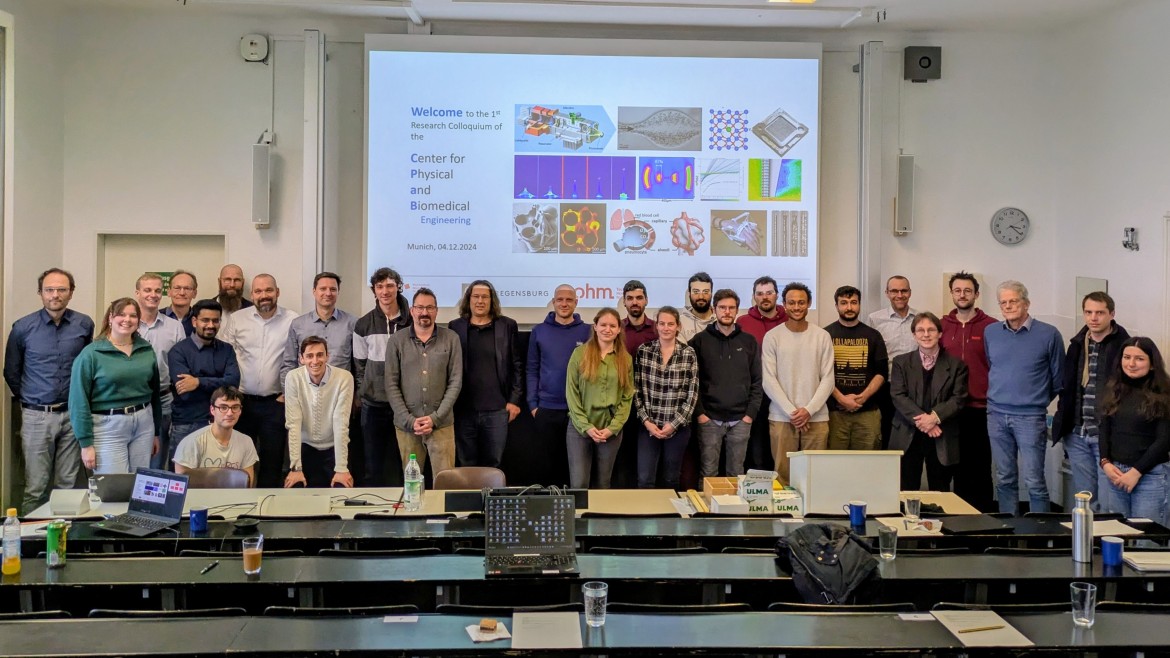
Pursuing a doctorate at the CPaB
At the CPaB inter-university Doctoral Research Centre, run by the partner institutions Munich University of Applied Sciences (HM), the East Bavarian University of Applied Sciences (OTH) Regensburg and Nuremberg University of Applied Sciences (Ohm), graduates of physics and engineering-related subjects can pursue a doctoral degree. Depending on the focus of the doctoral thesis – which may emphasise either the fundamental or the applied aspects of this field – the doctoral degree awarded will be either Dr. rer. nat. or Dr.-Ing.
Doctoral candidates at this Doctoral Research Centre are supervised by professors with strong research backgrounds from the partner universities and can benefit from the breadth of academic expertise as well as the numerous support and networking structures available at all the universities. In consultation with the doctoral candidates, the Doctoral Research Centre offers an accompanying doctoral programme. In addition, the partner universities offer a general accompanying doctoral programme.
You can download the following documents here:
Admission to the CPaB Doctoral Research Centre
To be accepted into the CPaB, a written (digital) application must be submitted via the docDaten system. Please note the following:
- Step-by-step guide to registering with DocDaten (Quick Start)
- A supervision agreement and a project proposal must be drawn up with the supervisor and uploaded to docDaten in signed form prior to registration. We recommend using our guide to help structure the project proposal.
- University degrees and the higher education entrance qualification must be uploaded to docDaten and either presented for verification of the originals or submitted as certified copies. If you are submitting documents in person (possible at HM, OTH Regensburg or Nuremberg Technical University), please make an appointment via promotionszentren@hm.edu (HM) in all cases.
- Once registration has been successfully completed, an application for acceptance (online form) must be created in docDaten. This must be signed by the doctoral candidate and their supervisor and uploaded to docDaten. In addition, the data summary for the application, bearing the original signature, must be submitted to the CPaB office.
Contact:Dr Tina Scheibe
The Centre for Physical and Biomedical Engineering (CPaB)
The Centre for Physical and Biomedical Engineering (CPaB) at Munich University of Applied Sciences is an interdisciplinary Doctoral Research Centre that focuses on applying the latest findings and methods in physics to develop innovative applications in the fields of biomedicine, sensor technology and microsystems engineering. The intelligent integration of these methods gives rise to physical and biomedical systems with previously unattainable functionalities.
The Centre’s approach is based on the knowledge-driven methodology of physics, in which technological or biomedical applications are developed from a sound understanding of physics. Key methodological areas include high-resolution microscopy, mechanical investigations, time-resolved spectroscopy and advanced data science methods, including AI-based approaches. A key feature of the centre is that it covers the entire innovation chain, from physical analysis and modelling right through to application in the form of functional samples and prototypes.
Doctoral candidates receive a high-quality, interdisciplinary education at the interface between physics and technological implementation. Depending on the focus of the doctoral thesis, the degree awarded will be either a Dr. rer. nat. or a Dr.-Ing. The research focuses on the application of the latest physical technologies to address current issues in the aforementioned fields and on the development of innovative functionalities.
The centre offers a research-intensive environment with an established network of research institutions, industry and clinical centres, which facilitates practically-oriented research and the development of solutions to current social and economic challenges. In addition to specialist qualifications, doctoral candidates are also taught social skills so that they can apply the specialist knowledge acquired during their doctorate in a solution-oriented manner.
The Centre for Physical and Biomedical Engineering thus acts as a bridge between fundamental physical knowledge and technological applications, and provides a platform for research and development at the cutting edge of physical and biomedical engineering.
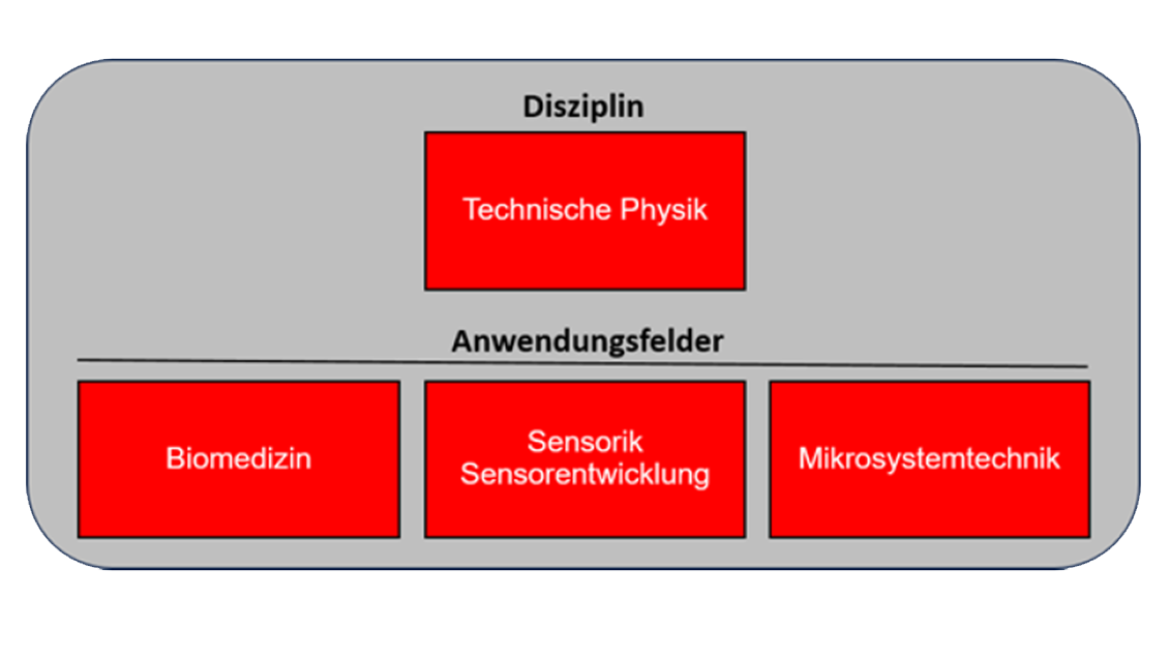
(Please note that the chart is only available in German.)
Professor-level members of the CPaB
The CPaB comprises a total of 21 Professors, of whom 10 are based at the HM, 7 at OTH Regensburg and 4 at TH Nuremberg.
The members are distinguished by their strength in applied research, as demonstrated in particular by the external funding they have secured and their publications. Furthermore, all members are represented on key national and international committees and standards bodies – in some cases in leadership roles – and, through networks of experts built up over many years, are directly involved in the practical implementation and transfers of the relevant research findings. Furthermore, many professors are active as reviewers for academic journals, conference organisers or research grant applications.
Bodies of the CPaB
| Prof. Dr. rer. nat. Hauke Clausen-Schaumann | Management |
| Prof. Dr.-Ing. Lars Krenkel | Deputy Head |
| Prof. Dr.-Ing. habil. Rainer Engelbrecht | Deputy Head |
| Prof. Dr.-Ing. Lars Krenkel | Chairmanship |
| Prof. Dr. rer. nat. habil. Uwe Zeitner | Member |
| Prof. Dr.-Ing. Sebastian Dendorfer | Member |
| Prof. Dr. rer. nat. Andreas Stute | Member |
| Prof. Dr. Heinz Huber (Dr. rer. nat.) | Deputy |
| Prof. Dr.-Ing. Thomas Schratzenstaller | Deputy |
| Prof. Dr. rer. nat. Michael Mayle | Deputy |
| Name / University / Department / Email | Field of specialisation |
| Prof. Dr. rer. nat. Hauke Clausen-Schaumann Hochschule München Department of Applied Sciences and Mechatronics | Tissue engineering, biofabrication, mechanobiology and mechanochemistry |
| Prof. Dr. rer. nat. Gregor Feiertag Hochschule München Department of Electrical Engineering and Information Technology | Assembly and Joining Technology, Sensor Technology, Materials for Electrical Engineering |
| Prof. Dr. rer. nat. Christine Maria Greif Hochschule München Department of Systems, Processes and Communication | Data Science & Applied Mathematics |
| Prof. Dr. rer. nat. Thomas Hellerer Hochschule München Department of Applied Sciences and Mechatronics | Multiphoton microscopy, biophotonics, super-resolution microscopy |
| Prof. Dr Heinz Huber (Dr. rer. nat.) Hochschule München Department of Applied Sciences and Mechatronics | Photonics and laser technology |
| Prof. Dr. Robert Huber (Dr. rer. nat.) Hochschule München Department of Engineering and Management | Bioprocess engineering, microbioreactors, online monitoring of bioprocesses, bioprocess technology, industrial biotechnology |
| Prof. Dr. rer. nat. Alfred Kersch Hochschule München Department of Applied Sciences and Mechatronics | Physical Modelling and Simulation |
| Prof. Dr. rer. nat. David Kostner Hochschule München Department of Engineering and Management | Molecular biology, industrial and molecular biotechnology, microbial biopolymers, renewable raw materials |
| Prof. Dr. rer. nat. Johannes Roths Hochschule München Department of Applied Sciences and Mechatronics | Applied Physics, Photonics |
| Prof. Dr. rer. nat. habil. Uwe Zeitner Hochschule München Department of Applied Sciences and Mechatronics | New fabrication technologies for optical micro- and nanostructures |
| Prof. Dr. rer. nat. Rudolf Bierl Regensburg University of Applied Sciences, Eastern Bavaria Department of Applied Natural and Cultural Sciences | Sensors |
| Prof. Dr.-Ing. habil. Valter Böhm Regensburg University of Applied Sciences, Eastern Bavaria Department of Mechanical Engineering | Engineering Mechanics |
| Prof. Dr. rer. nat. Mikhail Chamonine Regensburg University of Applied Sciences, Eastern Bavaria Department of Electrical Engineering and Information Technology | Sensors, Measurement Technology, Smart Materials and Structures |
| Prof. Dr.-Ing. Sebastian Dendorfer Regensburg University of Applied Sciences, Eastern Bavaria Department of Mechanical Engineering | Biomechanics, Musculoskeletal Simulation, Engineering Mechanics |
| Prof. Dr.-Ing. Lars Krenkel Regensburg University of Applied Sciences, Eastern Bavaria Department of Mechanical Engineering | Biomolecular fluid mechanics |
| Prof. Dr.-Ing. Thomas Schratzenstaller Regensburg University of Applied Sciences, Eastern Bavaria Department of Mechanical Engineering | Development and admission of medical devices, bespoke implants, point-of-care implants, minimally invasive implants and implantation techniques, additive manufacturing for medical devices, laser manufacturing of implants |
| Prof. Dr. rer. nat. Rupert Schreiner Regensburg University of Applied Sciences, Eastern Bavaria Department of Applied Natural and Cultural Sciences | Applied Physics, Microsystems Engineering |
| Prof. Dr.-Ing. habil. Rainer Engelbrecht Nuremberg University of Applied Sciences Electrical Engineering, Precision Engineering, Information Technology | Fibre-optic components and systems, fibre-optic sensor technology, optical metrology, non-linear fibre optics, photonics and laser technology, medical applications |
| Prof. Dr. rer. nat. (habil.) Ralf Lösel Nuremberg University of Applied Sciences Applied Chemistry | Immunochemistry: ELISA and similar techniques; purification and conjugation of antibodies and antibody fragments; in vitro methods for allergy diagnosis; mass spectrometry (ESI, MALDI); cell culture; in vitro assays for pharmacological research |
| Prof. Dr. rer. nat. Michael Mayle Nuremberg University of Applied Sciences Applied Mathematics, Physics and General Subjects | Multiphysics simulation, sensor technology, ultrasound |
| Prof. Dr. rer. nat. Andreas Stute Nuremberg University of Applied Sciences Applied Mathematics, Physics and General Subjects | Optical quantum technologies (for quantum computers, sensors and communications), photonics, multiphoton lithography (3D printing of microscopic optical components), femtosecond laser writing of refractive index structures |
Contact person
