Doctoral Research Centre of Integrated Buildings (PZIB)
The Doctoral Research Centre of Integrated Buildings (PZIB) brings together research expertise in the fields of planning and design, construction and production, operation and use, and maintenance and recycling.
Written (digital) application for admission to the Doctoral Research Centre of Integrated Buildings (PZIB) via the DocDaten system
- An application for approval (online form) is generated following successful registration on docDaten and must be signed by the doctoral candidate and his or her supervisor and uploaded to docDaten. Furthermore, the application’s data summary, bearing the original signature, must be submitted to the PZIB administration office.
- A supervision agreement and a profile must be drawn up with the supervisor prior to registration and uploaded to docDaten once signed
- supervision agreement (template in German)
- Project outline (guidance document) (both templates in German)
- University degrees and the higher education entrance qualification must be uploaded to docDaten and either presented for verification of the originals or submitted as certified copies. If you are submitting documents in person (possible at Hochschule München, OTH Regensburg or Nuremberg Tech), please make an appointment in all cases via promotionszentren@hm.edu (HM).
- University degree certificates, including transcripts and Diploma Supplements (bachelor's degree and master's degree)
- Higher education entrance qualification (HZB)
If your complete application is received by 3 June 2026, 23.59, the PromA will then make a decision on your application on 1 July 2026.
If your complete application is received by 9 September 2026, 23:59, the PromA will then make a decision on your application on 7 October 2026.
If you have any questions, please contact: promotionszentren@hm.edu
General information on the doctoral programme can be found in the Rahmenpromotionsordnung (RPromO). The specific requirements for the Doctoral Research Centre of Integrated Buildings (PZIB) can be found in the Fachspezifische Promotionsordnung (FPromO).
The doctorate programme
Doctorate
The PZIB Doctoral Research Centre awards the academic degree of Doktor der Ingenieurwissenschaften (Dr.-Ing.) in accordance with §3 of the FPromO
Forms of the dissertation
- Monograph
- Dissertation based on published work
Entry requirements for the doctoral programme
A degree in engineering in accordance with §9 of the FPromO:
- Civil Engineering
- Energy and Building Services Engineering
- Mechanical Engineering
- Electrical Engineering
- Computational Engineering
- Environmental Engineering
- Computer Science
- Architecture
- Natural Sciences
- Mathematics
- or provide evidence of a comparable degree
Above-average degree classification – an overall mark of at least 2.5 or higher in accordance with §9 of the FPromO
- Any deviating conditions are set out in the FPromO
- Any doctoral aptitude test that may be required is governed by §10 of the FPromO
Supervisor
The principal supervisor must be a member of the PZIB; however, it is further stipulated that one of the reports must be drawn up by a person who is either a university professor or who meets the requirements set out in §13(2) and (3) of the AVBayHIG, in order to ensure the quality of the assessment.
Registration
Written (digital) application for admission to the Doctoral Research Centre of Integrated Buildings (PZIB) via the DocDaten system
The Doctoral Committee decides on admission.
Accompanying doctoral programme:
In addition to the provisions of the RPromO, PZIB doctoral candidates must fulfil the following mandatory requirements in accordance with §6 of the FPromO:
- annual and active participation in research colloquia, presenting the progress of their research at least three times in total
- to present the work for discussion amongst the national or international specialist community during the doctoral programme, with at least two publications, conference or symposium papers
- Doctoral candidates must be integrated into the academic environment of at least one of the partner universities.
- The Doctoral Committee may grant an exemption at the request of the doctoral candidate.
Doctoral Candidates’ Representative Committee
As part of the self-governance of the Doctoral Research Centre, the position of doctoral candidate representative may be filled.
Information on the title page of the dissertation
- the title of the dissertation,
- the doctoral degree your are aiming for,
- the name of the Doctoral Research Centre,
- the names of the partner universities, specifying the supervising university,
- the full name of the doctoral candidate,
- the names of the supervisors,
- the names of the assessors.
Expert
- The Doctoral Committee may, in justified cases, commission further expert reports during the course of the procedure, e.g. if the supervisor, who is also a reviewer, is not, or is no longer, a member of the Doctoral Research Centre at the time of admission to the doctoral procedure; if the initial reviews do not provide the necessary breadth of expertise; or if the interdisciplinary nature of the written doctoral thesis makes a further review advisable.
- The Doctoral Committee may appoint further professors from the partner universities as members with voting rights.
Oral examination:
- A public academic presentation lasting approximately 30 minutes, delivered extemporaneously, followed by a public discussion on the objectives, approaches and findings of the doctoral thesis
- A closed-door defence lasting approximately 60 minutes, attended only by the candidate and the members of the examination board.
The oral examination may be conducted with the aid of audiovisual telecommunications technology; §25 of the RPromO applies.
If your monograph includes publication-based elements, or if your doctoral thesis is publication-based and the publications were co-authored, please submit the relevant author contribution statement.
Regardless of the form of publication chosen in accordance with the RPromO, the approved version of the doctoral thesis must be made available in digital form to the supervisors, the examiners and the Doctoral Research Centre PZIB for internal use only.
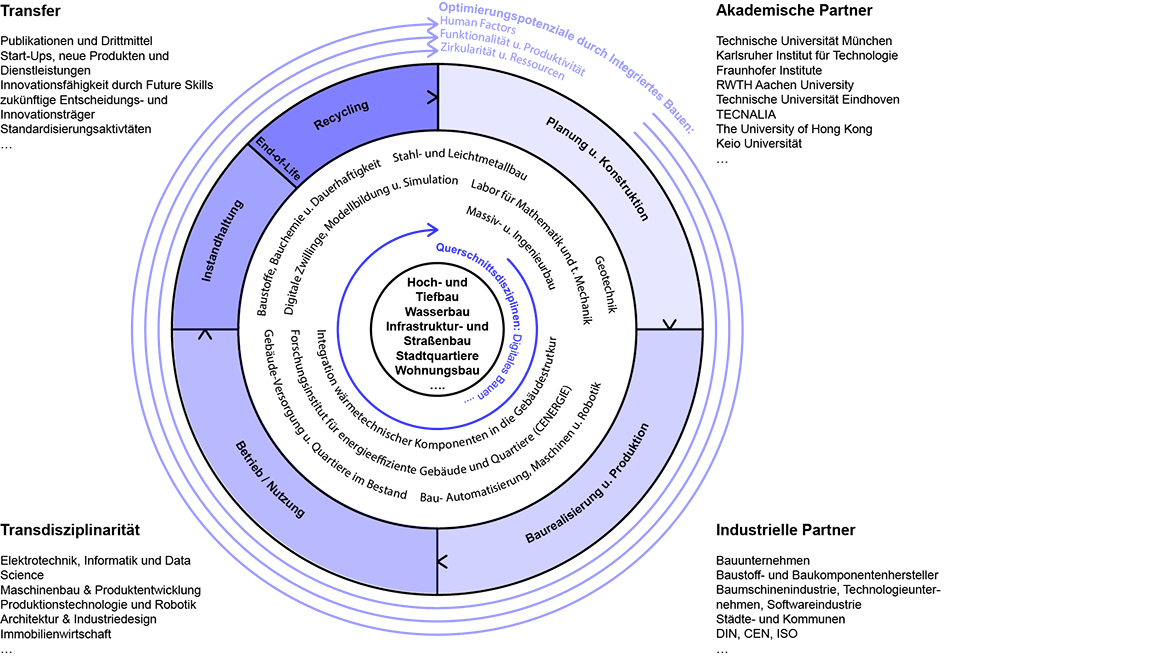
The Doctoral Research Centre of Integrated Buildings (PZIB) reflects one of the key research areas at HM, Ohm and OTHR. Against the backdrop of the major challenges posed by climate change, limited resources and technological and societal transformation, the members of the PZIB are convinced that strategies, standards, planning principles and processes in the construction sector must be reviewed, redesigned and adapted. As part of this interdisciplinary research, the nature of conventional construction is being fundamentally re-examined and supplemented with creative solutions, with the aim of constructing the buildings of the future in a more sustainable and resource-efficient manner, operating them in a more energy-efficient and durable way, and ultimately integrating them into the circular economy through recycling or reuse.
This holistic approach aims to successfully bring together expertise in materials and structural engineering, traditional construction methods such as concrete, steel and façade construction, the climatic effects encountered in the fields of civil and hydraulic engineering, infrastructure and building services engineering, utilising innovative tools such as digitalisation and automation as the basis for future planning and execution.
The four areas – planning and design, construction and production, operation and use, maintenance and recycling (see figure; in German) – are covered by the members across their respective fields:
This broad spectrum of subject areas enables the development of joint research priorities with diverse and holistic perspectives, and thus innovative solutions with a high potential for implementation. The approach is characterised by close collaboration between practically-oriented researchers and highly motivated early career researchers. At this level, there is already intensive collaboration through the Bavarian Science Forum (BayWISS). In 2018, the BayWISS Collaborative Research Centre for Infrastructure, Construction and Urbanisation was founded, with HM University as its host university. One of the two spokespersons is Prof. Dauberschmidt (HM), and the steering committee also includes a representative from the partner university, Prof. Neidhart (OTHR).
Academic staff members of the PZIB Doctoral Research Centre
The PZIB comprises a total of 21 academic members, of whom 11 professors are based at the HM, 4 at Ohm University and 7 at OTH Regensburg. The professors comprehensively cover the field described above by specialising in steel construction and welding technology, concrete and binder technology, building materials science and building physics, deep foundations, bridges and civil engineering structures, renovation of existing buildings, glass and façade construction, adhesive bonding, energy systems, automation in the construction industry, digitalisation in the building trades and smart cities. Through ‘Integrated Design and Construction’, they are, as it were, focused on a key area that defines the profile of the HM and its partnership with OTHR.
The members have demonstrated the required outstanding achievements in applied research. Collectively, they have secured external funding totalling approximately 13.5 million euros and produced 230 publications during the survey years covering the year in which the application was submitted. Furthermore, all members are represented on key national and international committees and standards bodies – in some cases in leadership roles – and, through long-established networks of experts, are directly involved in the practical implementation and transfers of the respective research findings. In addition, many professors serve as reviewers for academic journals, conference organisers or research grant applications.
Pursuing a doctorate at the PZIB Doctoral Research Centre
As the inter-university Doctoral Research Centre (PZIB) of the cooperating universities HM, Ohm and OTHR, graduates in civil engineering, energy or building services engineering, building climate control, computational engineering and related subjects can, for example, pursue a doctorate and be awarded the academic degree of Dr.-Ing. The PZIB is the first and currently the only Doctoral Research Centre at Bavarian Universities of Applied Sciences to have been granted the right to award doctorates in these fields.
At the PZIB Doctoral Research Centre, doctoral candidates are supervised by research-active professors from both universities and can benefit from the academic breadth and numerous support and networking structures offered by the universities. The Doctoral Research Centre offers a subject-specific accompanying doctoral programme, in consultation with the doctoral candidates. In addition, the partner universities offer a general accompanying doctoral programme.
At the Doctoral Research Centre, you can pursue a doctorate whilst employed at one of the partner universities or in an external role in academia or industry. If your doctoral project does not fall within the range of topics covered by the Doctoral Research Centre, you still have the option, as before, of undertaking a cooperative doctorate at one of the partner universities. Further information can be found under ‘Prospective doctoral candidates’.
Governing bodies of the PZIB
| Christian Schuler Hochschule München | Management |
| Thomas Neidhart OTH Regensburg | Deputy Head |
| Dirk Carstensen Nuremberg University of Applied Sciences | Ohm | Deputy Head |
| Chairmanship | Deputy |
| Christian Schuler Hochschule München | Thomas Neidhart OTH Regensburg Dirk Carstensen Nuremberg University of Applied Sciences | Ohm |
| Member | Deputy |
| Christoph Dauberschmidt Hochschule München | Thorsten Stengel Hochschule München |
| Klemens Rother Hochschule München | Imke Engelhardt Hochschule München |
| Christian Schweigler Hochschule München | Natalie Essig Hochschule München |
| Mathias Obergrießer OTH Regensburg | Thomas Linner OTH Regensburg |
| Name / University / Department / Email | Field of specialisation |
| Prof. Dr.-Ing. habil. Dirk Carstensen Nuremberg University of Applied Sciences | Ohm Department of Civil Engineering | Hydraulic Engineering and Technical Hydromechanics |
| Prof. Dr Christoph Dauberschmidt Hochschule München Department of Civil Engineering | Building Materials Science, Fundamentals of Civil Engineering, Repair and Refurbishment of Existing Buildings |
| Prof. Dr.-Ing. Arno Dentel Nuremberg University of Applied Sciences | Ohm Department of Mechanical Engineering and Supply Engineering | Air-conditioning technology, thermal building and indoor airflow simulation |
| Prof. Dr. André Dürr Hochschule München Department of Civil Engineering | Steel Construction and Structural Engineering |
| Prof. Dr. Imke Engelhardt Hochschule München Department of Civil Engineering | Steel Construction and Welding Technology |
| Prof. Dr. Natalie Eßig Hochschule München Department of Architecture | Building Design and Building Climate |
| Prof. Dr. Werner Jensch Hochschule München Department of Services and Building Services Engineering | Information technologies in building services engineering and building automation |
| Prof. Dr. Jörg Jungwirth Hochschule München Department of Civil Engineering | Solid construction and prestressed concrete, bridges and civil engineering structures, digital design and fabrication methods |
| Prof. Dr Wolfgang Krcmar Nuremberg University of Applied Sciences | Ohm Department of Materials Engineering | Coarse Ceramics, Thermal Process Engineering, Specialised Practical Course in Silicate Ceramics, Physics Practical Course |
| Prof. Dr.-Ing. Roland Krippner Nuremberg University of Applied Sciences | Ohm Department of Architecture | Building Construction, Future Energy Supply, Materials Technology (Wood/Concrete), Green Roofs, Building-Integrated Solar Technology, History of Architecture and Building Technology (Sonnenhäuser) |
| Prof. Dr. Andrea Kustermann Hochschule München Department of Civil Engineering | Construction chemistry, building materials, renovation |
| Prof. Dr Thomas Linner Regensburg University of Applied Sciences, Eastern Bavaria Department of Civil Engineering | Digital construction, with a focus on digital methods in construction production, data analysis and AI |
| Prof. Dr. Thomas Neidhart Regensburg University of Applied Sciences, Eastern Bavaria Department of Civil Engineering | Geotechnical engineering, railway construction, specialised civil engineering |
| Prof. Dr. Mathias Obergrießer Regensburg University of Applied Sciences, Eastern Bavaria Department of Civil Engineering | Digitalised Construction |
| Prof. Dr. Cornelius Preidel Hochschule München Department of Civil Engineering | Digital design, construction and operation; OpenBIM; interoperability and semantic data models; digital twins and data-driven methods in the construction industry; artificial intelligence in the construction industry |
| Prof. Dr. Klemens Rother Hochschule München Department of Mechanical, Automotive and Aeronautical Engineering | Structural integrity, operational reliability and fracture mechanics |
| Prof. Dr. Detleff Schermer Regensburg University of Applied Sciences, Eastern Bavaria Department of Civil Engineering | Solid construction, structural engineering |
| Prof. Dr. Christian Schuler Hochschule München Department of Civil Engineering | Glass and Façade Construction |
| Prof. Dr. Christian Schweigler Hochschule München Department of Services and Building Services Engineering | Heating and cooling using renewable energy, sorption heat pumps, energy systems |
| Prof. Dr Oliver Steffens Regensburg University of Applied Sciences, Eastern Bavaria Department of Applied Natural and Cultural Sciences | Building physics, building climate, building refurbishment, energy-efficient neighbourhood concepts, building simulation |
| Prof. Dr. Thorsten Stengel Hochschule München Department of Civil Engineering | Building materials, construction chemicals, fundamentals of civil engineering |
| Prof. Dr.-Ing. Charlotte Thiel Regensburg University of Applied Sciences, Eastern Bavaria Department of Civil Engineering | Materials used in construction |
| Prof. Dr. Simon Vilgertshofer Hochschule München Department of Civil Engineering | Construction Informatics |
| Doctoral representation | Deputy |
|---|---|
| Florian Spirkl OTH Regensburg | Lea Wendler – Hochschule München |
Contact: Andre Lindörfer