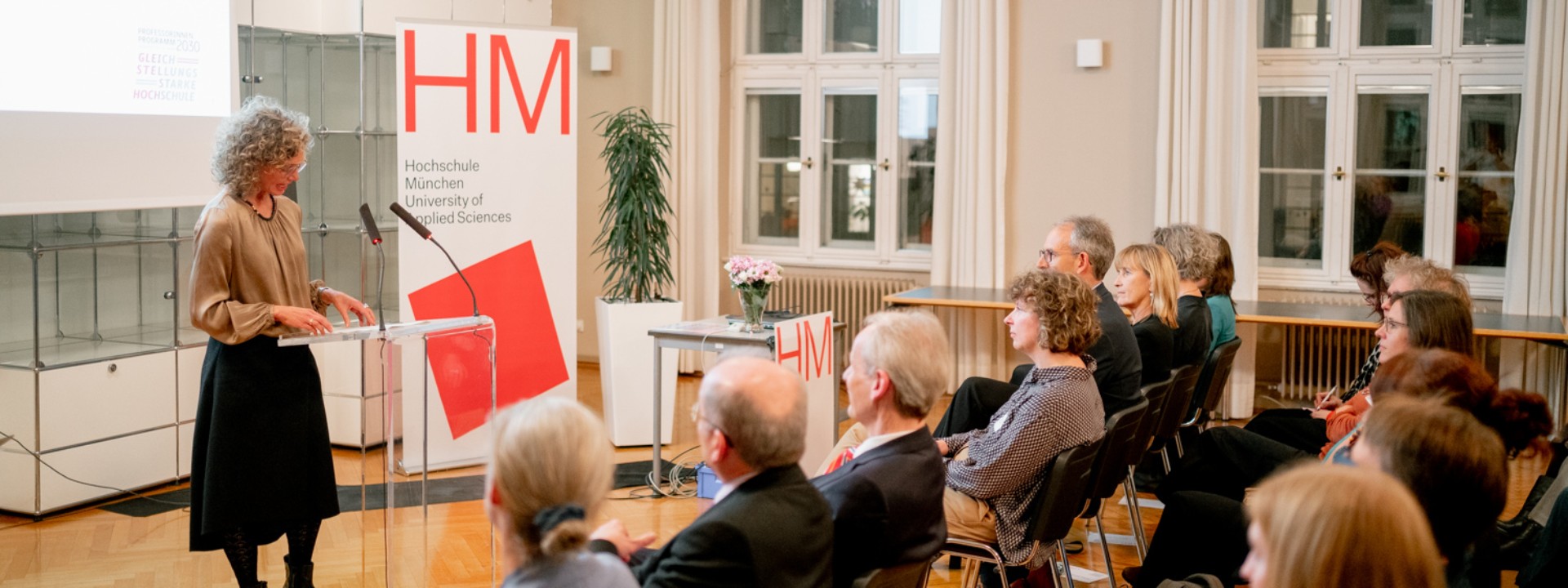
Hochschule München is a ‘university with a strong commitment to equality’
This is the fourth time that Hochschule München has made an application for the Female Professors Programme – and on each occasion it has impressed the selection panel with its well-thought-out gender equality strategies and their implementation. Furthermore, in 2024, Hochschule München was awarded the newly introduced ‘University with a Strong Commitment to Gender Equality’ distinction.
What is the Women Professors Programme 2030?
The Women Professors Programme is a funding scheme run by the federal and state governments aimed at increasing the proportion of women in top academic positions at German universities and thereby actively countering the so-called ‘leaky pipeline’. The programme specifically supports measures to promote equality at universities. The current funding programme runs until 2030. Universities can qualify by submitting a so-called ‘Gender Equality Plan for Parity at the University’. Applications are assessed by an independent panel. If the assessment is positive, the universities receive financial support for the initial appointment of female academics or artists to permanent W2 and W3 professorships. This start-up funding is then channelled into additional measures to promote gender equality at the respective university.
Objectives of the Women Professors Programme:
- The proportion of women in professorial posts and leadership positions at German universities is to continue to rise towards parity.
- Career paths for early-career female academics on their way to a professorship are to be supported, and the predictability of their career progression improved.
- The representation of women at all qualification levels is to be sustainably improved.
- A university culture that promotes gender equality and is gender-just, bringing about cultural change at both central and decentralised levels.

New ‘University with a Strong Commitment to Gender Equality’ designation As part of the ‘Professorinnenprogramm 2030’, the new ‘University with a Strong Commitment to Gender Equality’ designation is also awarded to universities that demonstrate a particularly strong commitment to gender equality. In Bavaria, alongside the HM, the Georg Simon Ohm University of Applied Sciences in Nuremberg and the University of Bayreuth received the award. The awarded universities may also apply for funding to support a female early-career researcher.
The ‘University with a Strong Commitment to Gender Equality’ award was presented on 4 December 2024.
Gender Equality Work at Hochschule München
Hochschule München (HM) has set itself the goal of achieving equality and equal opportunities for all staff categories. This commitment is set out in the University Development Plan 2023 (for the academic sector) and in the Gender Equality Strategy 2024 (for the non-academic sector).
HM’s equality strategy is based on the principle of gender mainstreaming. This aims to take gender and diversity aspects into account and implement them at all levels and across all areas of activity at HM. This requires clear strategic integration and a high level of gender competence in all departments, as well as gender-equitable organisational structures.
Gender equality work at the HM thus permeates all areas of activity: organisation and management, resources and processes, transfers, research and teaching. Numerous measures are derived from these areas of activity. For example, to increase the proportion of female professors, it is important that women feel that job vacancies are relevant to them and submit applications for them, and that appointment procedures are conducted in a gender-sensitive manner. This includes, amongst other things, raising awareness amongst appointment committees regarding unconscious (gender) bias, in order to ensure that the best candidates are selected. To inspire even more women to take an interest in STEM subjects and to attract them as early career researchers, STEM degree programmes should be designed and applied for in such a way that they are appealing and accessible to all genders, and that lecturers apply gender-sensitive teaching methods.
Further information on opportunities and initiatives for female professors, research assistants, PhD students, female undergraduates and those working in academic support roles can be found on the Equality and Diversity webpages.