Doctoral candidates
The Graduate School supports you as a student pursuing a doctorate throughout the entire doctorate process. Find out more about pursuing a doctorate at HM, as well as the advice and support services available.
As a doctoral candidate pursuing a doctorate at Hochschule München (HM), you will undertake a parallel professional development programme whilst working on your doctorate. In addition, various optional activities and advisory services are available. Furthermore, initiatives to promote internationalisation are encouraged, and support is provided for publications and conference travel.
The PhD process (organisational matters)
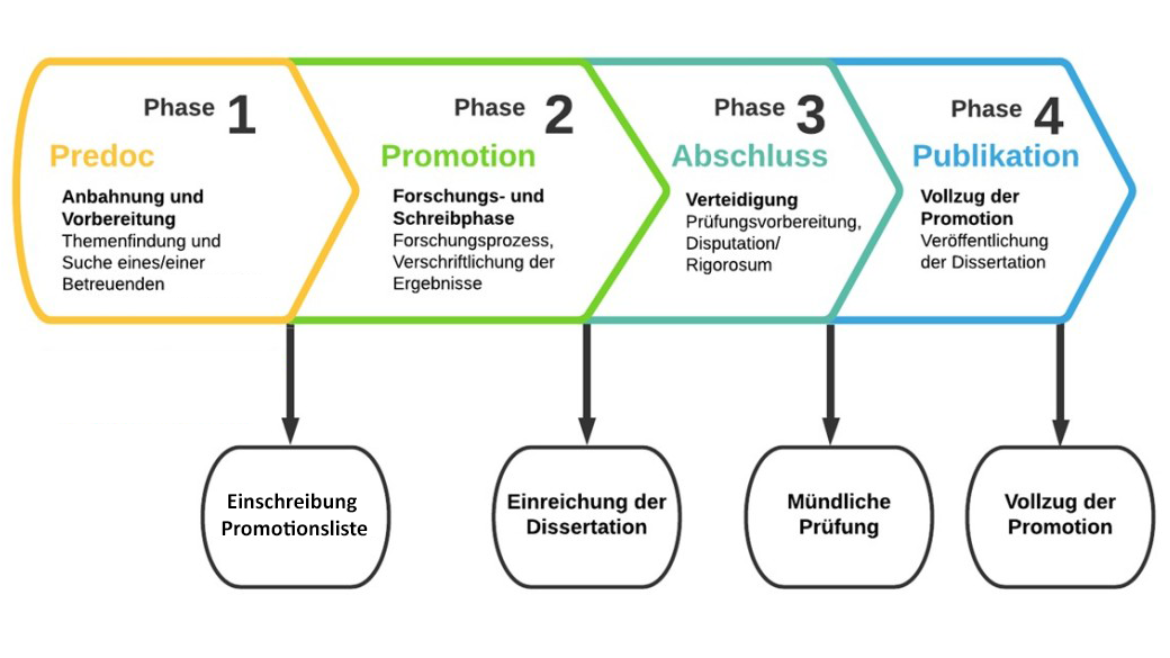
The doctoral process is divided into four stages:
• Initial stages of the doctorate programme
• Research and writing phase of the doctorate
• Final stage of the doctorate
• Publication of the dissertation for the doctorate
(Please note that the chart is only available in German.)
Entry requirements for the doctorate programme
To enrol at a Doctoral Research Center, prospective doctoral candidates must demonstrate an above-average degree classification (usually 2.5 or higher) in a subject area relevant to their doctoral project. This is usually evidenced by a Master’s degree certificate awarded by a University of Applied Sciences or a university, a Diplom degree (university) or a State Examination. The subject-specific doctoral regulations (FPromO) of the respective Doctoral Research Center set out the minimum requirements and specify the eligible degree programmes.
Selection of carers
During the initial phase, doctoral candidates select a Supervisor who will support them in identifying a research topic and answering academic questions relating to their doctoral project, and who is willing to take on the supervision. To this end, doctoral candidates usually contact professors at HM with a strong research background directly, or submit an application for a relevant advertised post. Job vacancies for research staff members are published here.
When undertaking a doctorate at one of the four doctoral centres in which Hochschule München is involved, a professor from Hochschule München may act as the primary supervisor; a professor from a university is not required to act as the primary supervisor. Supervision by a university professor may take place in the context of appointing a secondary supervisor or reviewer. As a rule, it is possible to complete a doctorate at Hochschule München within the doctoral centres without university involvement.
Furthermore, the doctorate programme is based on a collaborative approach, with the professor at Hochschule München generally acting as the second supervisor and examiner.
Together with their supervisor at the HM, doctoral candidates select the primary supervisor, who is affiliated to a university. The legal relationship governing the doctoral programme is then governed by the rules of the school, department or university to which the primary supervisor belongs.
A mentor may be appointed for both types of programme. Doctoral candidates are free to shape the mentoring relationship as they see fit. Mentors can provide support, both professionally and personally, with the doctoral project, as well as with networking and career planning, in difficult situations, or in settling into academic life.
It is advisable to maintain good communication between supervisors and doctoral candidates throughout the entire doctoral process and to seek the academic support of all supervisors involved on a regular basis.
Further information:
- Consider your motivation for pursuing a doctorate:
Why do you wish to pursue a doctorate, and what conditions do you need in order to produce a high-quality dissertation within a reasonable timeframe? - When taking up a post (as a research staff member) with the opportunity to pursue a doctorate:
Discuss with your line managers and potential Supervisors what is expected of you and to what extent you will be able to work on your doctorate whilst employed, or what scope you have to organise your time. When choosing a topic, your own ideas, interests and abilities play a key role, as do the assessments of your supervisors and subject experts. Particularly in the case of externally funded projects, the research questions are often already determined by the team’s preliminary work. Research the current state of the art in the field and clarify what (i.e. what innovative step) can be achieved in a doctoral thesis and by what means (academic, material). - Finding a supervisor at the HM:
Find out who might be a potential supervisor for you at the HM. Check whether the person is able to provide appropriate academic supervision for your doctoral project and whether there is a good personal fit between you and them. In most cases, this will be your Supervisor at the HM; however, for subject-specific reasons, it may in some cases make sense to choose another person at the HM as your Supervisor, or as an additional Supervisor or mentor. - Agree on the framework:
Discuss with your supervisor how much time you can realistically devote to your doctorate project, taking into account your work and family commitments. You should also discuss with your supervisors to what extent a doctorate might be beneficial or a hindrance to your career goals (whether within or outside academia). - In the case of a cooperative doctorate, ensure you have university supervision:
Discuss at an early stage with your HM supervisor who might be suitable as a collaborative supervisor at the university. Together with your supervisor, establish contact with a potential supervisor at a university to initiate doctorate supervision. Clarify the roles regarding primary supervision, secondary supervision and the final assessment. You are also welcome to contact the points of contact at the HM Graduate School or the coordination offices of the BayWISS joint doctoral programmes (see the glossary: BayWISS joint doctoral programme) for support with matching or finding supervisors at a university. - Selection of a mentor, if applicable:
A mentor may also be appointed. Doctoral candidates are free to shape the mentoring relationship as they see fit. Mentors can provide support, both professionally and personally, with the doctoral project, as well as with networking and career planning, in difficult situations, or when settling into academic life. - Initial supervision meeting and drawing up a supervision agreement:
At the start of your doctorate, arrange a joint meeting with your HM supervisor and your university supervisor, and use this meeting to clarify mutual expectations and the division of responsibilities. Set out the arrangements in writing in a supervision agreement. Templates for this are provided by the institution overseeing the doctoral programme (Doctoral Research Center or university). The supervision agreement should include the following elements (see also Glossary: Supervision Agreement)
- Details of supervisors and doctoral candidates
- Working title of the dissertation
- Work plan and timetable
- Frequency, duration, procedure and method of documenting supervision meetings
- How often and in what context the doctoral candidate presents their progress
- Commitment to adhering to the rules of good academic practice
- Participation in academic conferences
- Details of publications
As a general rule, supervision agreements can and should be revised from time to time. They serve as a common basis for regular meetings.
Clarification of the funding arrangements
The following options are available for financing:
- Appointment as a research assistant
- Employment under an external contract, e.g. with an industrial partner
- Scholarship
Here you will find our current job vacancies for research staff members and doctoral candidates.
For external employment opportunities, please contact the relevant companies directly.
Scholarships are awarded by foundations and support associations.
Steps required for admission to a Doctoral Research Center
Make sure you check which Doctoral Research Center is suitable for you in terms of your field of study. Enrolment at a Doctoral Research Center first requires you to be accepted as a doctoral candidate by the relevant Center, based on a written application (docDaten), which must include the following information and documents:
- A CV in German or English, which also provides details of your academic background. CVs in other languages may also be accepted in certain circumstances, subject to the provisions of the doctoral regulations (FPromO).
- Certificates, degree certificates and academic transcripts (Diploma Supplement, Transcript of Records) for all previous higher education qualifications, as well as proof of the higher education entrance qualification, in the form of certified copies. For foreign qualifications, a certified copy of the original document and a certified translation must be submitted.
- A supervision agreement (you can find the template for this on the website of the relevant Doctoral Research Center)
- A brief written proposal, in German or English, for the doctoral project to be carried out independently. The proposal should consist of the proposed topic, the current state of research, the objectives and the contribution of the thesis, together with a description of the approach and the methods to be used.
- A statement confirming that the doctoral examination for the intended doctoral degree has neither already been passed nor has it been definitively failed.
- A declaration that the German Research Foundation’s guidelines on ensuring good scientific practice, as well as the statutes or guidelines on compliance with good scientific practice of the host university, in their currently applicable versions, have been noted and will be complied with.
It is essential to check the specific requirements of the relevant Doctoral Research Center by referring to the corresponding FPromO. Please consult the Doctoral Research Centers’ websites thoroughly and, if necessary, contact the relevant points of contact to obtain detailed information on the necessary steps, such as admission to the doctorate. Here too, the supervision agreement is a key document that sets out the rights and obligations of doctoral candidates and their supervisors, and provides a framework for the planning and progression of the doctorate. Amendments to the agreement are possible and recommended during the course of the doctorate, in order to be able to respond flexibly to changes in the doctorate process.
Steps to be taken at the partner university
As a rule, the partner university requires you to sign a supervision agreement and to be affiliated with the university, which is usually achieved through enrolment or inclusion on the doctoral register. Please check the partner university’s website and consult the contact persons for doctoral candidates to find out about the requirements.
The HM also strongly recommends drawing up a supervision agreement. The supervision agreement supports doctoral candidates and their supervisors in planning and carrying out the doctorate programme. The document sets out mutual rights and obligations, as well as planned training activities, and establishes a timetable for the course of the doctorate programme. The agreements reached can and should be regularly adjusted as the doctorate project progresses.
For further information, see the Glossary: supervision agreement
Familiarise yourself with the doctoral regulations applicable to you in the subject area of the university where you wish to pursue your doctorate, and clarify how to become a member of the institution awarding the doctorate. As a rule, you can enrol at the university or be added to the doctoral register. You can find this information on the relevant websites or obtain it on request from the institution awarding the doctorate.
Acquiring membership of Hochschule München
In order to be eligible for HM’s support measures or the qualification programme, doctoral candidates must be members of the university. Members of the HM are all doctoral candidates who are supervised by a university lecturer or who have been accepted into a Doctoral Research Center. Membership ends upon completion of the doctorate, termination of the supervision agreement or withdrawal from the Doctoral Research Center.
Enrolment
Information on enrolment as a doctoral candidate can be found at the bottom of the webpage.
If you have any questions regarding enrolment, please contact Dr Marcus Müller-Ostermaier .
Phase 2 begins once a student has been successfully included on the doctoral register. During this phase, doctoral candidates are researchers and prepare their dissertation (either a monograph or a publication-based dissertation). In addition, they complete a training programme and may take advantage of other opportunities offered by the Graduate School.
Further information on the training programme and the Graduate School’s courses can be found here .
Further information:
Registering as a doctoral candidate: Please inform the HM that you have started your doctorate (by sending a change notification to personalverwaltung@hm.edu and gs@hm.edu). This is particularly important so that you can be officially registered as a doctoral candidate and receive direct information about all relevant events and support services.- Communication with supervisors:
Maintain regular contact with your supervisors, both at HM and, in the case of a cooperative doctorate, at the partner university. Take the initiative to approach your supervisors when you need their advice. If necessary, agree on a regular schedule for supervision meetings with your supervisors. Weekly discussions offer the advantage of enabling new insights to be gained through interaction and mutual support. You should also present interim results of your dissertation to your Supervisors at regular intervals (approximately every 6–12 months) and agree on a suitable setting for this (e.g. at the doctoral colloquium or doctoral seminar). - Dealing constructively with feedback:
Do not let criticism from your supervisors discourage you; instead, try to incorporate their feedback constructively into your work. If any aspects of the feedback are unclear to you or seem contradictory, seek a further discussion to clarify matters so that you can continue working in a focused manner. - Counselling and coaching:
Seek support for issues that you cannot or do not wish to discuss directly with your Supervisors (e.g. crises, conflicts, etc.). Your contact at the HM Graduate School will provide you with confidential support. You can arrange a counselling or coaching session with us at any time. - Seminars, publications and academic conferences:
Keep track of which courses/seminars you are required to complete during your doctorate in accordance with your doctoral regulations, supervision agreement and your employment contract at HM. The same applies to publications you are required to produce and conference participation. Financial support is available for conference travel and publications. The contact persons at the HM Graduate School will be happy to advise you. You can find more detailed information on the website.
The following requirements are set out in the doctoral regulations (PromO) of the doctoral centres:
- Presenting the progress of your doctorate/research at research colloquia (at least 3*)
- In addition, you will complete a training programme; the current range of courses is available at www.hm.edu/promotionsprogramm
- Present your doctoral project to the academic community for discussion; see also the FPromOs.
- Hold regular feedback meetings (link to template for minutes); depending on the Doctoral Research Center, this is 1* per semester
The requirements vary in accordance with the FPromO of the respective Doctoral Research Center
- Dissertation work plan and timetable:
Try to stick to the work plan and timetable agreed (ideally in the supervision agreement) and update your Supervisors at least every six months on your current progress. If certain work packages take longer than anticipated, or if specific circumstances or developments have led to a delay in your work, discuss this with your Supervisors and work together to find solutions. You should then adjust your work and timetable accordingly. - Networking:
Network with other doctoral candidates, particularly those working in your field of research. Courses on interdisciplinary skills at the HM and other higher education institutions, BayWISS networking events and annual colloquia (see Glossary: BayWISS Joint Doctoral Programme), as well as mentoring programmes such as the HM’s meant4science, provide an ideal forum for this. Integration into the working environment at your university’s chair also presents a good opportunity for networking. - Good scientific practice:
Please adhere to the rules of good scientific practice. If you have any questions or in the event of a dispute concerning good scientific practice, please contact the Graduate School or the HM ombudspersons (see www.hm.edu/gwp). - Personal responsibility:
Please use the resources and materials made available to you (e.g. via BayWISS) for your doctoral project responsibly.
As soon as the doctoral candidates and their supervisor at Hochschule München consider the dissertation to be ready for completion, the submission process can begin. It is advisable to obtain the consent of the primary supervisor in advance; in the case of a cooperative doctorate, this should also be obtained from the partner university. The entire dissertation submission process is governed by the rules set out in the RPrmoO/FPromO or by the PromO of the partner university. Please consult the relevant websites for further information and contact the relevant staff at the doctoral centres or the universities, schools or departments of your primary supervisor.
Further recommendations:
- Discuss the process for completing your doctorate with your Supervisors in good time and check your doctoral regulations for relevant information on this.
- Formal requirements & revision cycles:
Check your doctoral regulations to see which formal requirements you must comply with (e.g. title page, font, how many copies must be submitted and in what format, etc.). Also clarify with your supervisors in good time whether they have any specific requirements regarding the formal aspects of the dissertation (e.g. page count, appendices, figures, citation styles, etc.) and to what extent you should allow for rounds of revisions. - Oral defence:
Please check your doctoral regulations, paying particular attention to the requirements regarding the oral examination. You should also discuss the procedure and ways of preparing for the oral examination (e.g. the defence) with your Supervisors. If possible, attend the oral defences of other doctoral candidates who are due to complete their degrees before you. Furthermore, there is the option of dissertation defence training or coaching. Please feel free to contact your point of contact at the HM’s Early-Career Researcher Support programme.
In order to be officially entitled to use the title of Doctor, you must also have published your dissertation. Please check your doctoral regulations (RPromO and FPromOs) in good time for further details and discuss the requirements regarding publications to be submitted for submission with your Supervisors.
Glossary
The Bavarian Science Forum’s ‘Cooperative Doctorates’ specialist forum, with its current eleven cooperative doctorates, is setting new standards for cooperative doctorates. The cooperative doctorates are structured, predictable and transparent. This reinforces the high quality standards of the doctorate. BayWISS cooperative doctorates are topic-specific platforms and networks for young and experienced researchers. They strengthen the culture of academic exchange between Bavarian universities of applied sciences and research universities. The aim of the collaborative doctoral programmes is to promote the individual development of doctoral candidates, to offer a structured and predictable path to a doctorate, and to ensure academic quality.
- The BayWISS supervision agreement sets out the supervision arrangements, mutual expectations and milestones in the doctoral process.
- A systematic introduction to the scientific community is provided through external and internal networking events, as well as access to the postgraduate programmes at the universities within the Verbundkolleg.
- The colleges offer an exclusive platform for doctoral candidates (e.g. seminars, lecture series, symposia, professional development courses), which can be jointly organised in a proactive and needs-based manner.
- Financial support is provided for travel expenses, training courses, publications, conferences, workshops, registration fees, project-specific equipment, printing costs where applicable, etc.
- Advice and organisational support are provided by the programme coordinator.
The HM is a member of the following BayWISS collaborative research programmes (as at August 2022):
Joint College for Mobility and Transport
Joint Research Centre for Resource Efficiency and Materials
Joint Research Programme on Infrastructure, Construction and Urbanisation (The coordination office of the BayWISS Joint Research Programme on Infrastructure, Construction and Urbanisation is based at the HM and can be contacted at any time regarding any matters relating to the BayWISS joint doctoral programme (see below)).
Should any doctoral candidates or supervisors at the HM be interested in membership of other BayWISS research training groups, please simply get in touch with your contacts in the HM’s Early Career Researcher Support team.
The purpose of drawing up a written supervision agreement is to set out explicitly the mutual expectations, rights and obligations of doctoral candidates and Supervisors during the doctoral process. The DFG also recommends drawing up a supervision agreement.
Cooperative doctorate
Hochschule München has so far decided not to offer or recommend its own supervision agreement. This is because the university does not wish to oblige supervisors or doctoral candidates to complete multiple supervision agreements, given that, upon enrolment on a university’s doctoral programme, a supervision agreement drawn up by the respective university must in any case be signed by all parties involved in the doctoral process. Furthermore, when applying for membership of a BayWISS collaborative research group, an additional BayWISS supervision agreement must also be signed.
Doctorate at a Doctoral Research Center
If you are undertaking a doctorate at a Doctoral Research Center, you must sign a supervision agreement. You can find the form on the website of the relevant Doctoral Research Center.
Even under the Higher Education Innovation Act, most professors at Universities of Applied Sciences (UAS) in Bavaria do not have the right to award doctorates themselves and are not regarded as doctoral supervisors in the strict sense. It is therefore usually necessary to find a university professor with the right to award doctorates who will take on the university side of the supervision. A cooperative doctorate is defined as one in which the HM Professor is recognised as a supervisor, external examiner or examiner at the university awarding the degree. Some of the supervising professors at the HM have the relevant contacts and can assist you in finding a university supervisor. Academic coordination in selecting a research topic also plays an important role in this process. It is important to align your own ideas with those of your supervisors right at the start of the supervisory relationship.
Research staff members.
The Act on Fixed-Term Contracts in Academia grants universities a certain degree of flexibility regarding options for fixed-term contracts.
Further information on the Act on Fixed-Term Contracts for Researchers can be found here:
BMBF Act on Fixed-Term Contracts in Science
Legislation on the Internet: The Fixed-Term Academic Contracts Act







Enrolment
You can undertake enrolment as a doctoral candidate at both the partner university and HM, provided you can prove that you have already been accepted by a Doctoral Research Center or a university.
Enrolment takes place in accordance with Section 18 of the statutes governing the procedures for pre-registration, enrolment, leave of absence, re-registration and de-registration at Hochschule München (see below and under ‘Downloads’). Upon enrolment, doctoral candidates are entitled to make use of the following services provided by Hochschule München:
1. Setting up an IT account
2. Access to the buildings using a Legic card
3. University library lending services, including interlibrary loans and access to e-resources
4. Access to training courses run by the university library
5. Access to the university’s own courses (e.g. language or subject-specific courses), provided there are sufficient places available, and the award of the corresponding credit points
6. Option to use the departments’ loan services, e.g. IT hardware
Enrolment takes place online via:
www.primuss.de/status-fhm
As the application procedures are being set up between 1 and 14 November and between 1 and 30 April, no applications can be submitted during these periods. Enrolment is therefore always possible from 2 May to 31 October and from 15 November to 31 March of each year. Doctoral candidates can indicate during the registration process whether they wish to be enrolled with retroactive effect from the current semester.
This is the responsibility of the Studies Department. The doctoral candidate will be deregistered at the end of the semester in which they have successfully completed their oral examination for the doctorate.
Enrolment as a doctoral candidate is free of charge. Please note, however, that enrolment at the HM does not confer student status. You should therefore consider carefully whether enrolment is appropriate for you.
Social affairs
Hochschule München recognises the future challenges facing society and the economy and takes a critical yet open-minded approach to current issues, such as equal opportunities in education. As a large and diverse institution, the ‘university environment’ is characterised by a variety of personalities, experiences and ways of working.
For this reason, the university has set itself the aim of promoting diversity amongst its students and staff in both academic and administrative roles, harnessing the potential that arises from this diversity, and championing equal opportunities for all members of the university community. Here you will find further information on the measures in place and the relevant contact persons for this topic.
Downloads
Statutes, regulations, laws
- Research activities, career opportunities and working conditions at Hochschule München – Information for research staff members, doctoral candidates and postdocs
- Statutes governing the procedures for pre-registration, enrolment, leave of absence, re-registration and withdrawal from the Hochschule München of Applied Sciences
- Guidelines on Ensuring Good Research Practice: Hochschule München – Good Research Practice
- Part-Time and Fixed-Term Employment Act: TzBfG – Act on Part-Time Work and Fixed-Term Employment Contracts
- Act on Fixed-Term Employment Contracts in Academia: WissZeitVG – Act on Fixed-Term Employment Contracts in Academia
- Form for registering and updating the status of collaborative doctoral projects
Current doctoral projects at the HM
Here you will find a selection of the current doctorates at Hochschule München (as at 10 August 2026).